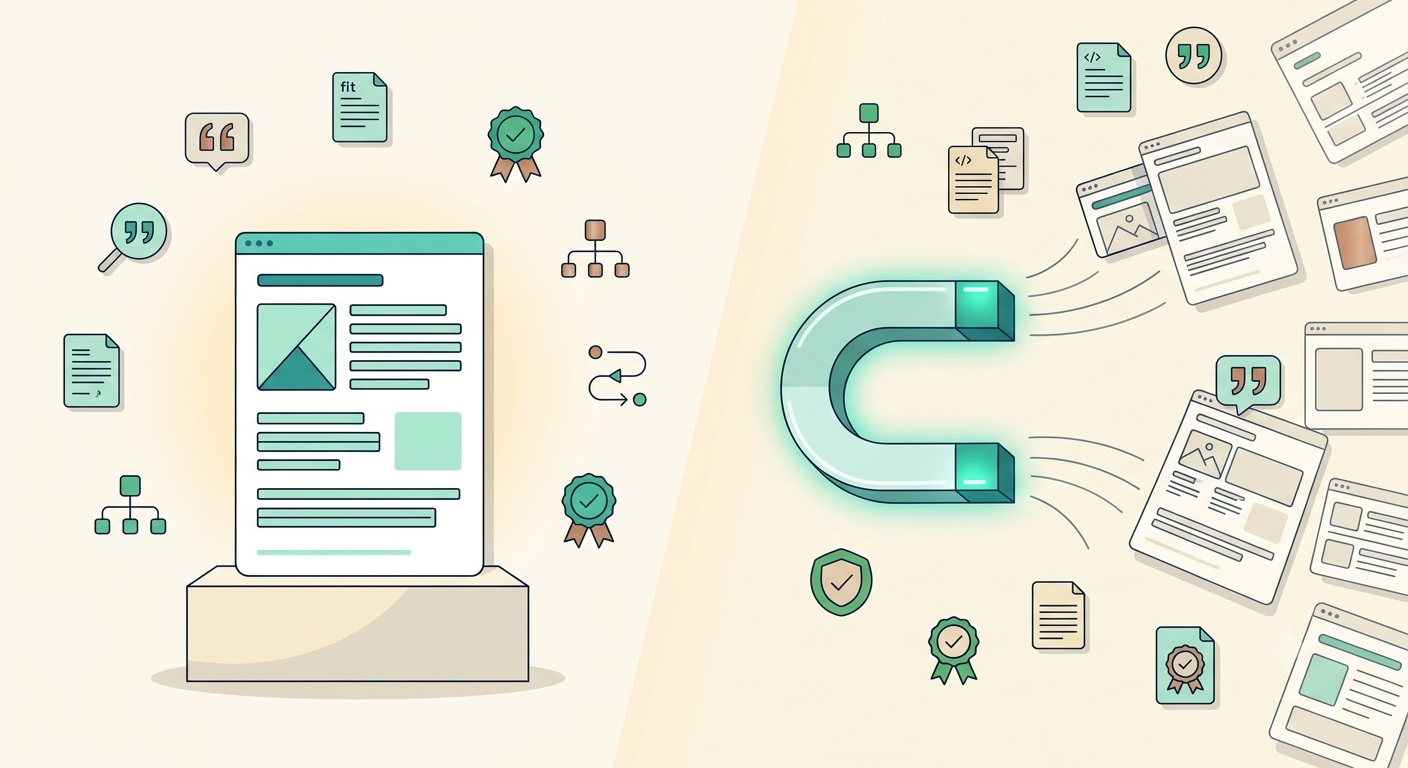
You built the better resource.
More research. More examples. More depth. You even have a cleaner design. But your competitor has 10x the referring domains, and their content is honestly just... fine.
So what gives?
The easy answer is to assume Google rewards the best-written page. It doesn't. Backlinks aren't prizes handed out for quality. They go to the pages that are easiest for other people to reference, trust, and attach their name to.
There's a gap between content that's good and content that earns backlinks. Most brands never close it because they're optimizing for the wrong thing.
The Linkability Gap
The Linkability Gap is the difference between content that answers a searcher's question and content that gives other websites a reason to reference it.
Most brands build content around three things: completeness, keyword coverage, and search intent. These are valid goals for content marketing. But earning backlinks from content depends on something entirely different.
Citation value.
The question you need to be asking isn't "Is this useful to my reader?" It's: "Would another website feel smarter, more credible, or more helpful by referencing this?"
That's a different bar. And most content doesn't clear it.
Good content answers a question. Link-worthy content is the kind that attracts backlinks naturally, earns editorial links, and becomes a citation-worthy reference point in its niche. It gives someone else a reason to point their audience toward you. Those are not the same thing, and confusing them is the core of the Linkability Gap.
The Difference Between Content That Ranks and Content That Earns Backlinks
Link-worthy content is content that provides original information, frameworks, resources, or insights that other websites can reference to make their own content stronger. Some people call these content assets. Others call them linkable assets. The label matters less than what they actually do: they give publishers a reason to cite you that has nothing to do with how well you've written for your own audience.
That definition matters because it shifts the entire production question from "what does my reader need?" to "what does my industry need to point to?"
Here's the honest breakdown:
Good content:
- Answers a question your audience is searching for
- Summarizes existing knowledge in an accessible way
- Competes for rankings in your niche
Link-worthy content:
- Adds something new to the conversation
- Gives people evidence they can use in their own arguments
- Provides a framework someone else can adopt and reference
- Becomes the place everyone points to when the topic comes up
The difference isn't effort. You can write a 4,000-word article and still produce something that nobody has a reason to cite. The difference is contribution.
Think of it like academic publishing. You don't cite a textbook because it explains something well. You cite the study that produced the finding. The internet works the same way. Original data, distinctive frameworks, and strong takes earn backlinks. Summaries of existing knowledge, however well-written, rarely do.
Here's a useful benchmark: a Backlinko and BuzzSumo analysis of 912 million blog posts found that 94% of all published content earns zero backlinks. Not "very few." Zero. That's not a distribution problem. That's a contribution problem. Most content fails to earn links not because it wasn't promoted well enough, but because nobody had a genuine reason to cite it.
The 5 Signals That Make Content Earn Backlinks
Not all content creates the same kind of link demand. After working across enough link building campaigns to see what actually attracts editorial backlinks, the pattern is consistent. The content that earns links naturally doesn't just satisfy readers. It sends a signal to publishers that this is something worth referencing.
Here are the five signals that do that reliably.
1. Original Data and Research
Nobody wants to cite another summary. They want to cite the source.
When you conduct original research, you become that source. Surveys, industry benchmarks, proprietary datasets, even informal polls with a decent sample size: these are things other writers actively need. And when they use your data, they link to you.
The signal here is authority transfer. Publishers aren't just recommending your content. They're borrowing your credibility to back up their own argument. That's fundamentally different from linking to a well-written guide. It's a citation, in the academic sense of the word.
BuzzStream's State of Digital PR report found that 94.8% of digital PR practitioners use data-led content as their primary tactic, ahead of expert commentary, hero content, and press releases. That number is high because data creates something no content marketing strategy can manufacture: scarcity. Only one source can be the original. A single well-promoted research study can earn more organic backlinks in a month than a dozen well-written guides earn all year.
2. Frameworks and Mental Models
This one is underrated, and it's where some of the strongest brands in any industry build their authority.
A framework turns messy, complicated information into something people can reference. It gives your audience language. Language spreads.
The signal is conceptual ownership. When you name something and define it clearly, you own that corner of the conversation. Publishers link to you not because you explained a concept well, but because you coined the way people talk about it.
Take something like a Topic Proximity Framework, which maps how closely related your content is to your core entity so Google can make stronger relevance inferences. Or an Entity Recognition Flywheel, which describes how brand mentions, structured content, and backlinks work together to reinforce what Google understands about your site. These aren't just concepts. They're tools someone can bring into their own thinking and attribute back to you when they explain it to someone else.
This is also how you build the kind of invisible authority that compounds over time. When other writers reach for language, they reach for the source. Make sure that's you.
3. Linkable Assets and Practical Resources
Not "ultimate guides." Those are a commodity at this point.
Actual resources: calculators, templates, databases, checklists, interactive tools. Things someone bookmarks and returns to. Things they share in a Slack channel because it solves a real, recurring problem. This is what people mean when they talk about linkable assets in any serious link building conversation. Not long articles. Functional things with standalone utility.
The signal here is utility that outlasts a single reading. These assets earn editorial links the same way software earns recommendations. People don't cite them because they're impressive. They cite them because they're useful, and they want their own readers to have access to them.
That's a fundamentally different reason to link than "this article was well-researched." It's: "my audience needs this." If your content crosses that line, it stops being content. It becomes infrastructure.
4. Strong Opinions and Contrarian Takes
The internet links to ideas worth discussing.
A post that says "here's how to build backlinks" is competing with ten thousand other posts saying the same thing. A post that says "most brands are chasing backlinks when they should be building topical authority" has a perspective. It creates conversation. People link to it in agreement, in disagreement, and as a counterpoint.
The signal is intellectual friction. A strong opinion gives other writers something to respond to. That friction is what drives links, shares, and ongoing mentions in a way that purely informational content almost never achieves.
This doesn't mean being contrarian for its own sake. It means being willing to stake out a position and defend it with evidence. More content is not always better. Backlinks are context signals, not just authority metrics. These aren't edgy claims. They're honest, defensible takes that most brands are too cautious to commit to publicly.
That caution is what makes them backlink-worthy when someone else actually says them. Natural link earning often starts with a willingness to say the thing your industry is tiptoeing around.
5. Expert Contributions and Digital PR
Expert commentary, unique perspectives, quotes in roundups, original takes on industry trends: this is where content crosses into digital PR for SEO territory, and that overlap is worth paying attention to.
The signal here is external validation. When your voice appears in publications other people already trust, you earn editorial links at scale while simultaneously strengthening your backlink profile with high-authority placements that genuinely move domain authority. This is how editorial link acquisition works at its best: not by asking for links, but by becoming someone worth quoting.
Editorial.Link's 2025 State of Link Building survey of 518 SEO professionals across agencies, in-house teams, and freelancers found that nearly half of respondents rate digital PR as the most effective link-building tactic. More than guest posting, skyscraper technique, and broken link building combined. That's not because digital PR is flashy. It's because contributing original perspectives to your industry is one of the most reliable paths to passive link earning, where your content and reputation do the outreach for you.
Every time you say something your industry hasn't said yet, you become a reference point. Do it consistently, and you become an authority.
Why Most "Linkable" Content Still Fails to Earn Backlinks
Here's where things get uncomfortable.
Most brands have read some version of the advice above. They produce research pieces and tools and frameworks. They still don't earn backlinks from content. The pieces sit there. Traffic comes and goes. Editorial backlinks never arrive. Usually it comes down to one of these four reasons.
It's too similar.
There's already a version of your content somewhere else, and that version got there first. No reason to cite yours instead of theirs. Content that attracts backlinks has to add something that doesn't already exist. If you're not genuinely contributing something new to the conversation, you're not linkable. You're just more of the same.
It has no unique takeaway.
Helpful isn't the same as reference-worthy. A post can be genuinely useful to a reader and still give another writer nothing to point to. The question isn't whether your audience learns something. It's whether another site's audience would benefit from being sent to you.
The best idea is buried.
This happens constantly. The most original insight in the article is sitting in paragraph seven, underneath three paragraphs of context-setting. If your distinctive angle isn't visible in the first scroll, most people who could have linked to it never found it.
There's no distribution plan.
Great assets still need discovery. Ahrefs studied 14 billion web pages and found that 96.55% of them get zero organic traffic from Google, mostly because nothing is linking to them. That's the chicken-and-egg problem at the heart of natural link earning: the assets that most deserve links often sit undiscovered because nobody helped them get their first traction. Outreach, passive link earning, and community distribution solve this. Publish-and-pray does not.
The Linkability Audit: Does Your Content Deserve Backlinks?
The Linkability Audit is a pre-promotion check to determine whether a piece of content has genuine citation value or just ranking potential. Before you push anything live or start outreach, run it through these five questions:
☐ Does it contain original information nobody else has published?
☐ Does it introduce a unique framework or way of thinking about the problem?
☐ Does it take a clear, defensible opinion?
☐ Is there something another site could reference that would make their content stronger?
☐ Is there a reason to mention your brand specifically, not just the idea?
If you're checking fewer than three of those boxes, you may have created well-optimized content. But you haven't created a link asset. Those are different products with different distribution strategies.
Optimized content can rank. Backlink-worthy content assets compound authority. Only one of those gets harder to dislodge over time.
How Link-Worthy Content Builds Momentum Over Time
Here's what the brands with the strongest backlink profile understand that most don't: backlinks are not a linear output. They're a compounding one.
A strong content asset earns backlinks. Those backlinks build domain authority. That authority makes your next piece more visible and more trustworthy before it's even published. That visibility earns more editorial links. That authority earns brand mentions. Those mentions build recognition. That recognition earns more inbound links and more direct outreach from publishers who've heard of you.
This is the authority flywheel. And it doesn't spin evenly across all your content. It spins fastest around the content that earns backlinks naturally. Those are the pieces with genuine citation value that publishers keep finding and referencing long after you stopped promoting them.
One well-constructed, genuinely original piece can trigger a cycle that carries your entire domain. That's why link building for SEO done well isn't about the volume of placements you can manufacture. It's about creating the kind of content that generates its own link demand over time.
Industry research from 2024 found that a meaningful share of SEO experts were focused specifically on creating valuable content assets like original research to naturally build authority, even as the rest of the market chased volume.
Volume scales mediocrity. Assets compound authority.
Stop Creating Content. Start Creating References.
The brands that earn the most backlinks are not always publishing the most.
They're creating things the industry needs to point toward. Data that journalists cite. Frameworks that practitioners adopt. Tools that teams share. Opinions that shift how people think about a problem.
That's the distinction worth internalizing. Not "how do I make more content?" but "what does my industry actually need a reference for?"
Most brands don't have a backlink problem. They have a citation-value problem. They're producing content that earns rankings but not editorial links. Content that gets read but not referenced. The goal isn't to create more content. It's to create content the industry has a reason to cite.
Answer that question honestly, and the backlinks follow.
Frequently Asked Questions
Why doesn't good content earn backlinks?
Because usefulness and citation value are different things. Content can satisfy a reader completely and still give no other publisher a reason to reference it. Good content answers a question. Backlink-worthy content adds something new: a finding nobody else has published, a framework others can adopt, an opinion worth responding to, or a resource people actively want to share. Satisfying your reader is necessary. It's not sufficient for earning organic backlinks.
Why does my content rank but not get backlinks?
Ranking and link earning draw on different signals. Content can rank well by matching search intent, building internal links, and establishing topical coverage. But earning backlinks from content requires other publishers to find a reason to cite you. That means original data, a distinctive framework, a strong opinion, or a resource their own audience would benefit from accessing. Rankings tell you Google finds you relevant. Backlinks tell you other publishers find you credible enough to reference.
What makes content link-worthy?
Link-worthy content adds something to the conversation that didn't exist before. That could be original research, a named framework, a clear and defensible opinion, or a genuinely useful resource like a calculator or database. The test: would another website's content be stronger, more credible, or more useful if it referenced yours? If yes, you have something worth citing. If not, you have a Linkability Gap.
How do you create content that earns backlinks naturally?
Start by identifying what your industry is missing. What question keeps coming up that nobody has answered with real data? What process is everyone doing differently because nobody has defined the standard? What conventional wisdom in your niche is actually wrong? Build your content around those gaps. Make sure the distinctive element is visible early, promote it actively through outreach and digital PR, and give other writers a reason to come back to it. That's how you earn backlinks naturally, without manufacturing placements or chasing guest post quotas.
Why do some pages get more backlinks than others?
Because they contain something original that other writers actively need. Data gives journalists a source. Frameworks give practitioners language. Strong opinions give commentators something to respond to. The pages that earn the most backlinks tend to be ones that serve other publishers' content goals, not just their own readers' questions. That's the core shift in content marketing for link building: from audience-first to citation-first.
Are long-form articles better for backlinks?
Length correlates with backlinks mainly because longer articles have more room for the things that create link demand: original research, detailed frameworks, comprehensive resources. The length itself isn't the variable. What longer content tends to contain is. A 500-word article with a genuinely original finding will outperform a 5,000-word summary every time.
What is a linkable asset?
A linkable asset is a piece of content specifically built to earn backlinks rather than just rank for a keyword. It could be original research, a free tool, a detailed template, a named framework, or a data study. The defining characteristic is that it gives other websites something valuable enough to reference on its own terms. Most content doesn't qualify. The pieces that do tend to attract backlinks passively, long after publication, because the citation value doesn't expire.
Want More Backlinks From Your Content?
LinkyJuice helps brands create content assets that people actually want to reference.
Research, insights, resources, and ideas that build authority... not just fill up your blog.
Book a call and build Your Link Strategy now.
About the Author
Davit Nazaretyan writes about link building, backlink audits, and SEO automation at LinkyJuice. His work focuses on separating what actually moves rankings from what just looks like it does: from cleaning up toxic backlink profiles to building outreach systems that hold up against algorithm updates. Connect on LinkedIn.