The Mistake Happens Before the First Email
Here's the biggest mistake in link building.
It happens before anyone sends an email.
When a campaign flops, everyone looks in the wrong place. Rewrite the outreach. Test new subject lines. Try a fancier tool for finding contacts.
None of that fixes anything. The real damage was done weeks earlier, when the team decided who to contact in the first place.
Ask a struggling team how they built their prospect list, and you'll usually get some version of: "we pulled competitor backlinks and found similar sites."
That's not research. That's just discovery. It tells you where links exist. It never tells you why. And a list built that way falls apart the moment someone opens an email, because it was never built on anything a publisher actually cared about.
Strategic teams start somewhere else entirely. Before they ask who to contact, they figure out what actually makes a publisher in that niche cite something. That one habit is the whole difference. It's why they keep finding opportunities before anyone else even knows to look. Not because they work harder. Because they're solving a different problem before outreach even starts.
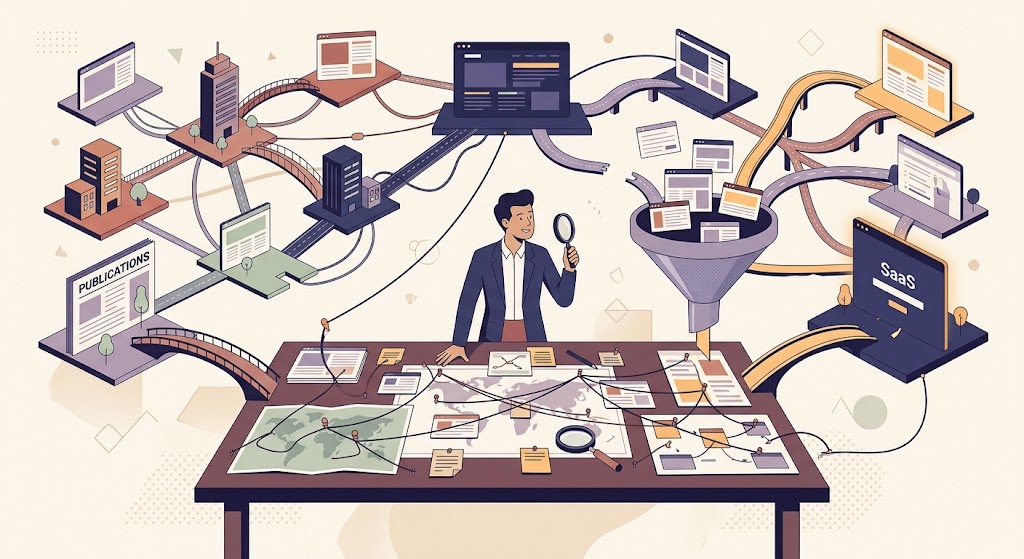
That's what real link research is: figuring out how citation behavior already moves through an industry, before you try to insert yourself into it. It's the thing every serious link building strategy is built on top of.
Two Hundred Emails vs. Nine
Picture two teams. Same B2B software niche. Same goal: earn links for a mid-market comparison tool.
Team One exports competitor backlinks, filters by domain rating, and ends up with a spreadsheet of about 200 sites. Decent template. Solid personalization. Batches go out on schedule.
A handful of smaller blogs link back, the kind that'll link to almost anything relevant. Someone calls it a modest win and quietly lets the campaign fade out.
Team Two doesn't touch a list yet. They spend a week just reading what already gets cited in that niche, and they notice something team one never checked: the sites that link out consistently aren't linking to comparison pages at all. They're linking to one specific benchmark report. It's two years old. It's the only independent usage data in the space that isn't coming straight from a vendor.
Every writer covering the topic is still citing stale numbers, because nothing newer exists.
That's the opening. Not a bigger list. An outdated source everyone's stuck quoting.
Team two builds a small, current benchmark study. They send exactly nine emails, all to publications already citing the old report. The pitch isn't "here's our tool." It's "the number you cited last quarter is two years old, here's what it actually is now."
Five of the nine reply within a week.
Same niche. Same budget. Same starting point. The only difference was what happened before either team opened an inbox.
Real Backlink Analysis vs. a Spreadsheet Exercise
Most teams that say they "do competitor research" are really just doing competitor discovery. The gap between the two comes down to one thing: did anyone bother writing down why a link happened, not just where it points?
An experienced link builder isn't scanning a competitor's backlinks for domain rating. They're sorting each one by cause. Original data. A free tool. A quote from someone credible. A resource roundup. A comparison.
Why does that matter? Because the cause tells you whether the link is repeatable. A backlink on its own is just a fact about one page. The cause behind it is a fact about the whole industry's citation habits, and that's a far more useful thing to know.
Here's the tell that separates a junior pass from a senior one: can the analysis spot the difference between a link that happened because two writers know each other, and a link that happened because the content genuinely gave a publisher something worth pointing to?
The first is a coincidence wearing a URL. The second is a signal, and it'll keep repeating for anyone who produces something similar. Mix the two up, and a hundred-row spreadsheet turns into a hundred wasted emails.
Here's a signal worth hunting for: the same publication citing more than one piece of a specific content type, over an extended stretch. Not one lucky mention. Three or four instances of the same underlying cause, across different competitors and different months.
That kind of repetition is rare enough that most teams never think to look for it, and common enough that it's usually sitting right there in the data once someone actually checks.
Once you've found a repeatable cause, matching it to specific pages and prospects is its own discipline. This article is about what has to happen before that even starts.
Where Writers Get Stuck
Reading backlinks for cause tells you what already earns links. Here's the harder, more useful question: where are writers currently stuck, reaching for a source and settling for something mediocre because nothing better exists?
That shows up as topics competitors mention constantly but never really answer. Questions that keep popping up in forums with no real answer. Data nobody's bothered to collect. Resources that used to be current and quietly went stale, with nothing to replace them.
The benchmark report from earlier is the clearest example. Everyone kept citing it because the alternative was citing nothing at all.
Build the thing that fills that specific gap, and most of the persuading is already done before you send a single email. Nobody needs convincing that a fresh number is useful when they've spent two years quoting a stale one.
You're Reading SERPs Wrong
Search results almost always get treated as a ranking signal. That wastes most of what they're actually telling you.
Keyword research asks: what do people search for?
A better question: what does this space already treat as worth pointing to?
Those two answers overlap, but not completely. A page can rank on page one without a single external site linking to it. A page ranking fourth can be the thing every other article quietly cites.
Read a SERP with that second question in mind and you'll start noticing things: which formats keep winning across related queries, not just one. Where the top-ranking pages are thin or stale despite obvious demand. Which URLs keep getting referenced across competing results, not just ranked on their own. Where visibility clearly hasn't caught up to quality yet.
None of that is keyword research. It's reading the exact same data everyone already has, for a signal almost nobody bothers looking for.
The Pages Everyone Forgot to Check
Some of that visibility gap isn't a hole waiting to be filled. It's a resource that already exists, quietly sitting on page three.
A page can be genuinely strong and still be invisible, for reasons that have nothing to do with quality. It launched during a site migration. The internal links pointing to it broke two redesigns ago. The person who wrote it left the company and nobody picked up the promotion.
Usefulness and visibility only loosely track each other. The gap between them is where a specific, low-competition opportunity sits, usually because no competitor has bothered checking whether it's even there.
Look for older, still-credible resources that lost visibility for reasons that have nothing to do with the content itself. Research that was solid on release and never got picked up. Genuinely useful pages sitting several spots lower than they deserve.
Finding these takes almost no tooling and almost no competition. Most teams are too busy scanning what's already ranking well to check what should be.
Why Different Industries Reward Different Kinds of Links
Every niche has its own unwritten rules about what earns a citation. Nobody writes them down. They just repeat, consistently, for anyone paying attention.
The reason isn't arbitrary. A publisher cites whatever makes their own job easier, or their own credibility stronger, and that changes depending on what the job actually is.
SaaS writers are usually helping someone choose between vendors, so they reach for benchmarks and comparisons. Finance writers need a number to anchor a claim, so statistics and market data travel well. Professional services writers are selling judgment, not data, so frameworks and expert commentary do the work instead. Education writers are helping someone get something done, so guides and explainers earn the links.
None of that matters much on its own. What matters is knowing how to check it before you build anything.
Look at which two or three formats keep showing up as the thing that got cited, across a dozen articles, not just one. Look at what kind of number gets repeated: adoption figures, cost figures, satisfaction figures. Publishers in a given space rarely mix and match once they've settled on one. Look for the same publication linking to the same category of resource across different competitors. That's a far stronger tell than any single link. And look for the topics where a writer is visibly settling for a weak source, because that's demand with no supply behind it yet.
Get that pattern right and you'll know roughly what kind of resource will earn attention before you've built anything. Broken link building, for instance, only earns its keep in spaces where resource pages and curated lists are already the norm. It fits a specific pattern. It isn't a universal starting point.
The Citation Intelligence Model
This process has a name, because it's specific enough to deserve one. It's not a rebrand of standard backlink analysis. It's a different sequence entirely, one where outreach is the last step instead of the first.
Market Signals → Authority Patterns → Content Opportunities → Linkable Assets → Relevant Publishers → Strategic Outreach
What's actually being cited, and by whom, becomes a read on the habits underneath it. Those habits narrow into specific, identifiable gaps: an outdated stat, an unanswered question, an under-cited resource. The gap dictates the shape of the asset, what format it should take, built around what kind of evidence, for this specific niche's habits. The asset dictates the publisher shortlist. Not everyone remotely relevant. Only the sites whose own history says they'd cite exactly this.
Outreach is the narrow, final move. It's exactly what team one skipped, and exactly why nine emails from team two beat two hundred from team one.
It's also the real case for protecting the research when a team hands off execution. The emails aren't what win a campaign. Knowing who's worth emailing, and with what, is. A brilliant pitch sent to the wrong two hundred people is still a pitch that fails.
What Actually Breaks Most Link Campaigns
A short list of habits shows up again and again:
Chasing domain rating instead of topical fit. Treating a one-time research pass as permanent while the gap underneath it quietly closes. Running the same playbook across industries that reward completely different kinds of content.
Any one of these caps a campaign's ceiling. A few of them together are usually the real story behind "we tried link building and it didn't work."
Frequently Asked Questions
Why does competitor backlink analysis usually fail to produce good opportunities?
Because most teams stop at collecting the links instead of figuring out why each one happened. A spreadsheet of competitor backlinks shows where links exist, not what caused a publisher to add them, and without that cause, there's no way to tell a repeatable pattern from a one-time coincidence.
What's the real difference between backlink discovery and backlink research?
Discovery produces a list of URLs that link to competitors. Research explains why each link exists, whether that reason is likely to repeat, and where else the same conditions might show up. The list is a byproduct of research, it was never the actual goal.
How do experienced link builders analyze competitor backlinks differently?
They sort each backlink by cause instead of by domain rating, original data, a free tool, a quote, a comparison, and look for the same publication citing the same type of resource more than once. That repetition is what separates a signal worth building around from a coincidence that happened to land a link.
How can I tell why a specific backlink actually happened?
Look at what the linking page was doing right before it added the link, was it missing current data, quoting a stale statistic, or citing a lone source because nothing better existed. The cause is usually visible in the content surrounding the link, not in the link itself.
How do I find repeatable citation patterns instead of one-off backlinks?
Check whether the same publication has linked to the same category of resource more than once, across different competitors and different months. One backlink only proves something worked once, possibly by circumstance. Three or four instances of the same underlying cause is what indicates the pattern will repeat.
Why isn't a single backlink enough evidence of a real opportunity?
A single backlink is just a fact about one page, it could reflect a personal relationship between writers as easily as it reflects a genuine citation habit. A repeatable pattern, the same type of resource getting cited across multiple unrelated sources, is a fact about the whole industry's behavior, which makes it far more predictive.
What signals actually indicate a real link opportunity?
The strongest signal is the same publication citing the same category of resource multiple times over an extended period, across different competitors. Other signals include writers visibly settling for a weak or outdated source and topics that get mentioned constantly but never really answered anywhere in the niche.
How do I find content gaps that competitors have missed?
Look for topics competitors mention often but never fully answer, forum questions with no solid response, data nobody has collected, and resources that used to be current and quietly went stale. These gaps show up as writers reaching for a source and settling for something mediocre because nothing better exists yet.
How should SERPs be used for link research instead of just rankings?
Instead of asking what people search for, ask what the space already treats as worth citing. Look at which formats keep winning across related queries, which top-ranking pages are thin despite obvious demand, and which URLs keep getting referenced across competing results rather than just ranking on their own.
Why are DR and authority metrics insufficient for backlink research?
DR and similar metrics measure a domain's overall authority, not why any specific page linked out or whether that reason will happen again. Chasing high domain rating instead of topical fit and citation cause is one of the most common habits that caps a campaign's results before outreach even starts.
When should backlink research happen relative to content creation?
Before content gets created. Research is what reveals the actual gap worth filling, an outdated stat, an unanswered question, an under-cited resource, and that gap should shape the asset's format and evidence. Content built first and justified with research afterward usually solves a problem nobody in the space was actually stuck on.
Why do different industries reward different types of linkable content?
A publisher cites whatever makes their own job easier or their credibility stronger, and that changes by industry, SaaS writers reach for benchmarks and comparisons, finance writers need hard numbers, professional services writers rely on frameworks and expert commentary. Running the same content playbook across industries with different citation habits is a common reason campaigns underperform.
How do I identify what a publisher actually wants to reference?
Check which two or three content formats keep showing up as the thing that gets cited across a dozen articles in that niche, not just one. Also look for the same publication linking to the same category of resource across multiple competitors, since that pattern is a stronger indicator than any single link.
How often should citation research be repeated for an ongoing link building campaign?
On a rolling basis. A gap that's undervalued today stops being useful the moment enough teams notice and start filling it, and in most niches that doesn't take long. Treating a one-time research pass as permanent is one of the more common reasons campaigns lose effectiveness over time.
The Advantage Is Timing, Not Volume
The advantage was never a bigger list.
Teams that consistently earn links are working from a sharper read of the space. What's already being cited. Why. What's still missing.
That read has a shelf life, worth saying plainly: the best openings exist because nobody's noticed them yet. The moment they're obvious, they're table stakes, not an edge.
The teams that keep winning aren't sending the most outreach. They're the ones who spotted a citation habit forming while it was still quiet enough that nobody else was competing for it.
About the Author
Davit Nazaretyan writes about link building, backlink audits, and SEO automation at LinkyJuice. His work focuses on separating what actually moves rankings from what just looks like it does: from cleaning up toxic backlink profiles to building outreach systems that hold up against algorithm updates. Connect on LinkedIn.