Answer engine optimization is the practice of getting your brand named and cited inside AI-generated answers — ChatGPT, Perplexity, Google's AI Overviews, Gemini — rather than only ranking in a list of blue links.
That definition is easy. What almost nobody tells you is where those answers actually get their material. We pulled the numbers from four large citation studies and ran our own, and the pattern is consistent across every engine: answer engines overwhelmingly cite third-party sources, not the brands being discussed.
Which means AEO is much less about rewriting your own pages than the industry currently pretends, and much more about where else your brand appears.
What Answer Engine Optimization Actually Is
Answer engine optimization (AEO) is the work of becoming a source that AI systems quote when they answer a question in your category. To get cited by AI, you need two halves working together:
- On-site: making your own content machine-readable and extractable — direct answers, clean structure, consistent entity naming, schema
- Off-site: making your brand present and accurately described on the third-party pages answer engines already draw from
Most AEO guides cover the first half and stop. The citation data says the second half is where the outcome is decided.
AEO is sometimes used interchangeably with GEO (generative engine optimization) and "LLM SEO". The labels differ; the mechanics are the same. If you specifically want Google's AI Overviews, we cover that separately in AI Overview optimization.
Where Answer Engines Get Their Citations
Here is what the largest available datasets show.
ChatGPT: one encyclopedia dominates
Profound analysed 680 million citations between August 2024 and June 2025. Wikipedia alone accounts for 47.9% of ChatGPT's top-10 source share, and 7.8% of citations across the full dataset.
No brand owns Wikipedia. The single largest input into ChatGPT's answers is a third-party reference site you cannot optimise, only earn a place in. So if you are asking how to rank in ChatGPT, the honest answer starts with where ChatGPT already looks — not with your own pages.
Perplexity: a forum dominates
Reddit accounts for roughly 46.7% of Perplexity's top-10 source share.
Again: not a property you own. A discussion platform where your brand is either being talked about or it is not. We have written about what actually works on Reddit, and why most brands get it wrong.
Google AI Overviews: ranking is not the ticket
Conductor analysed 167,867,680 AI Overview citations from US searches between 15 June and 15 August 2026:
- 57% of citations go to pages outside the organic top 10
- Position 1 is cited 24.9% of the time, but accounts for only 8.5% of all citations
- 43% of citations come from top-10 pages
Surfer's study of 46 million citations across 36 million AI Overviews (March–August 2025) sits alongside it, and reporting on that dataset puts roughly 43% of AI Overview citations on Google-owned properties including YouTube.
Different engines, different favourite sources, one shared conclusion: the answer is assembled from other people's pages.
Our Own Analysis: 71% of Citations Were Not the Vendor
Large datasets tell you the shape. We wanted to know what it means for a specific buying query, so in October 2026 we pulled the AI Overview for eight US queries across commercial, comparison, and informational intent, and classified every cited domain.
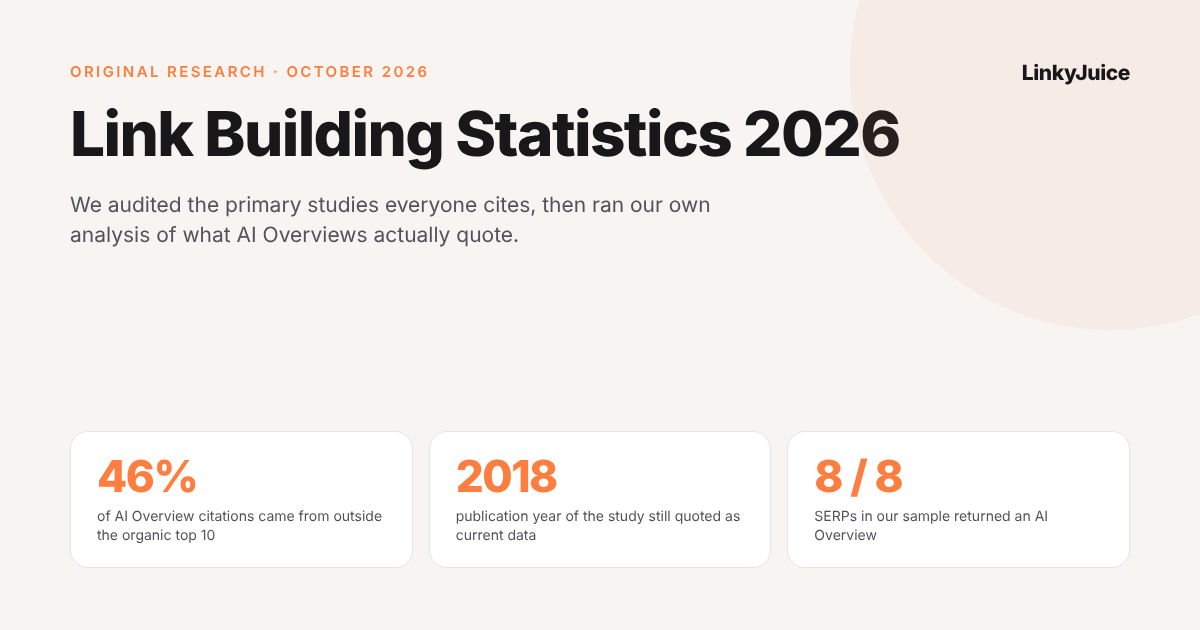
All eight returned an AI Overview. They produced 48 citations from 39 distinct domains — only 5 domains appeared on more than one SERP.
- 71% of citations pointed at a domain other than the vendor being discussed
- 46% came from domains outside the organic top 10 (44% excluding YouTube), with per-query overlap ranging from 20% to 75%
- 19% were UGC or reference sites — Reddit, Quora, YouTube, Wikipedia
And on the two queries where someone is actively trying to hire:
- "link building services" — 7 citations, 0 agency websites
- "digital pr agency" — 7 citations, 0 agency websites
Fourteen citations across two high-intent commercial searches, and not one went to a company that sells the service. Every citation was a comparison post, a listicle, or an editorial roundup that named those companies.
Our sample is 48 citations, not 680 million, and we are not presenting it as more than a directional check. But it agrees with every larger study, and it isolates the thing those studies average away: on the queries that produce revenue, the vendor's own site is frequently not in the answer at all.
Why Third-Party Presence Moves AI Search Visibility
If citations go to third parties, the question becomes which brands those third-party pages name — and what predicts whether an engine associates your brand with your category.
Ahrefs studied 75,000 brands, correlating AI Overview visibility against on-site and off-site signals. The Spearman coefficients:
- Branded web mentions — 0.664
- Branded anchors — 0.527
- Branded search volume — 0.392
- Domain Rating — 0.326
- Referring domains — 0.295
- Number of backlinks — 0.218
- URL Rating — 0.18
Brands in the top quartile for web mentions averaged 169 AI Overview mentions. The next quartile averaged 14 — a twelve-fold gap.
Seer Interactive found the same ordering testing ChatGPT brand mentions, with Domain Rating at 0.25 and raw backlink count at 0.10. Kevin Indig measured a 0.334 correlation between chatbot mentions and branded search volume.
Correlation is not causation, and Ahrefs is explicit that every factor it measured was moderate to weak. But three independent datasets produce the same ranking, and it inverts how link building is usually sold:
- How often your brand is named elsewhere out-correlates how many backlinks you have by roughly three to one
- Branded anchors rank second, above Domain Rating and far above link count
- Raw backlink volume is the weakest signal measured
The practical reading: a thousand DR-filtered links with commercial anchors move the weakest signal in the set. A hundred accurate mentions on pages that actually cover your category move the strongest one.
The AEO Strategies We Run at LinkyJuice
This is the off-page half, in the order we run it.
1. Citation-source mapping
We take your commercial queries, run them through Google AI Overviews, ChatGPT, and Perplexity, and record every domain cited. That produces a ranked target list — typically 5 to 15 domains per query — of the pages the engines are already quoting. No DR filter, no generic prospect scrape. The actual sources.
Because citation sets are query-specific and shallow — 39 domains produced our 48 citations, with almost no repetition — these lists are small enough to work through deliberately.
2. Getting named on the cited pages
Once we know which comparison post, category roundup, or review page sits in the cited set, the job is getting you accurately represented on that page. That is outreach, editorial relationships, and a stronger case than whoever currently holds the slot. It uses the same machinery as competitor backlink analysis, aimed at a different target list.
3. Unlinked mention conversion
Mentions out-correlate links, and most brands already have mentions nobody claimed. We find them, check the description of your brand is accurate — an inaccurate mention teaches the model the wrong thing — and where it makes sense convert them into links.
4. Reference and UGC presence
With Wikipedia at 47.9% of ChatGPT's top-10 share and Reddit at 46.7% of Perplexity's, these are not side channels. They demand earned, policy-compliant participation: genuine notability for reference sites, and real contribution rather than promotion on forums. Done badly this backfires, which is why we treat it as a distinct discipline.
5. Digital PR for mention volume
The fastest lever on branded web mentions is digital PR: original data, expert commentary, and research journalists cite by name. This is also what gets you into the editorial pages that answer engines favour.
6. Branded anchor and entity consistency
We weight anchor profiles toward branded and natural phrasing, and keep your brand described the same way across every placement. Inconsistent naming splits the entity; consistent naming compounds it.
7. Relevance over authority
A high-DR placement in an unrelated niche does nothing for whether a model links your brand to your category. Topical relevance builds that association, and the correlation data supports it — context-bearing signals beat raw authority metrics.
How To Measure AEO
Rankings will not tell you whether this is working. Track instead:
- Citation presence — for each target query, does your brand appear in the answer, on which engine, and via which source
- Source coverage — what share of the cited domains for your queries mention you at all
- Mention volume and accuracy — how often you are named, and whether the description is right
- Branded search volume — the downstream signal that correlates at 0.392
A brand can hold position 4 and be absent from the answer, or sit at position 14 and be quoted in it. Those are different problems, and ranking reports cannot distinguish them. The same argument applies to link reporting generally, which is why we push clients toward measuring real impact instead of DR.
Four AEO Mistakes Worth Avoiding
- Treating AEO as a schema project. Markup helps a model parse a page it already chose. It does not get the page chosen.
- Buying link volume. Backlink count is the weakest correlated signal in every dataset above. Volume without relevance or brand context moves almost nothing.
- Ignoring inaccurate mentions. A wrong description on a frequently cited page is worse than no mention. It actively trains the association you do not want.
- Optimising only for Google. ChatGPT leans on Wikipedia, Perplexity on Reddit, AI Overviews partly on Google's own properties. One engine's playbook does not transfer.
Where AEO Goes Next
Two things look likely, and we are willing to be judged on them.
Citation share replaces rankings as the headline metric. When 57% of AI Overview citations already come from outside the top 10, position tracking is measuring an increasingly weak proxy for visibility.
The cited set gets contested, then closes. Right now those sets are small and cheap to enter. As more brands work out which specific pages are being quoted, placement on them gets priced accordingly and incumbents get harder to displace. The inexpensive window is open now.
For the longer version of how the underlying economics are shifting, see our 2026 link building statistics breakdown, and for the on-page half of this work, how to design content AI can actually use.
The Short Version
Answer engines build answers out of third-party pages. Across 680 million ChatGPT citations, 168 million AI Overview citations, 75,000 brands, and our own SERP analysis, the signal that best predicts whether you appear is how often and how accurately your brand is named on sites you do not own.
That has always been what good link building and digital PR produced. AEO did not replace it. AEO is what it is now for.
If you want the citation-source list for your own queries and a plan for getting into it, book a call.