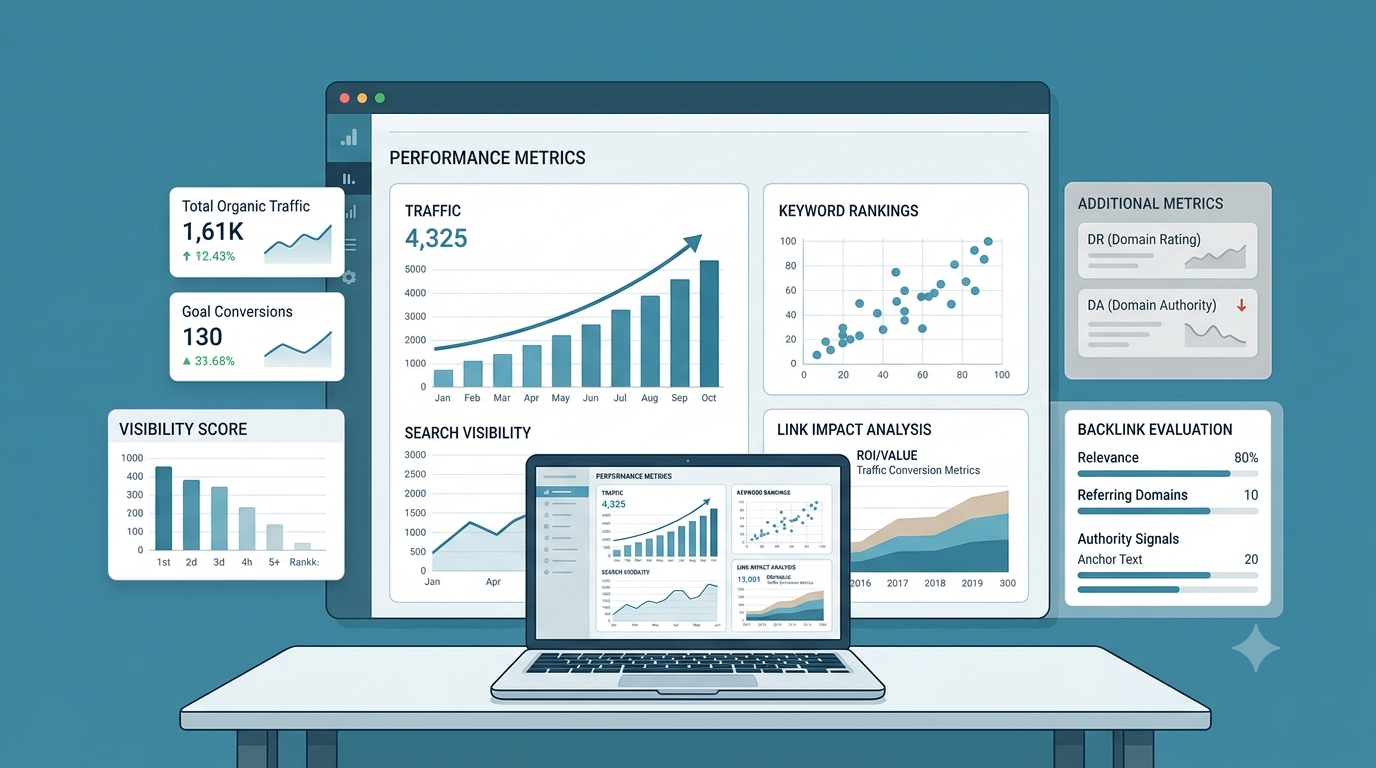
In the SEO world, link building is something very few people know how to measure properly.
Most teams focus on domain rating (DR), domain authority (DA), or raw backlink counts to estimate success. These metrics don’t say anything about real business outcomes like traffic, rankings, or revenue.
In this guide, we’ll explore what link building ROI looks like in 2026 and how to measure it in ways that support real SEO and business growth over time.
The Problem With DR and DA
You can use domain-level metrics like DR and DA for quick comparisons, but they don’t give you the bigger picture of how search engines assess performance.
They don’t show:
- keyword rankings movement
- organic traffic growth
- conversion optimization results
- revenue per visit
For instance, two sites can have identical DR but completely different SERP positions and traffic profiles.
This is mainly because real SEO results are influenced more by page authority, internal linking structure, contextual anchor text, and how link equity flows through a site (not just a single domain score).
So, if you’re only relying on DR or DA tracking, you’re measuring potential, not actual results.
What You Need Before Measuring Link Building ROI
Before measuring ROI, the first step is to build a solid foundation for link building. Otherwise, you’ll always have misleading data.
Strong campaigns usually start with:
- Creating linkable content (make sure your pages are worth linking to)
- Having a clear page structure and internal linking to distribute authority
- Using contextual anchor text aligned with your keyword strategy
- Optimizing conversion so traffic can actually turn into results
- Focusing on baseline metrics so you know what “growth” actually means
Backlink audits follow. They help you do a bunch of things like review existing links, understand how your current DA is distributed, determine page authority strength, and whether your site jas any harmful backlinks that hurt performance.
Without this foundation, even high-quality backlinks can’t reel in ranking gains.
What Changes When Link Building Works
With successful link building, expect to see meaningful improvements across multiple layers.
For starters, your keyword rankings and SERP positions for target pages improve. This usually leads to organic traffic and higher visibility for buyer intent keywords (not just informational ones).
Over time, your site gains more traffic, and your brand awareness improves.
But the deeper impact is often on quality: higher referral traffic, better engagement metrics like time spent on page and improved bounce rates, and stronger conversion outcomes when visitors match search intent.
That’s where link building starts influencing real business results, not just SEO dashboards.
Competitor and Link Quality Analysis (This Is Where Strategy Actually Starts)
One of the most overlooked parts of ROI measurement is understanding what you’re competing against.
Before you decide how many links you need, you should be doing proper competitor link analysis using tools like Ahrefs.
This includes:
- backlink gap analysis (what competitors have that you don’t)
- backlink profile audits (quality and structure of their links)
- link prospecting based on real patterns, not guesswork
It’s not about counting links, but rather understanding link quality and diversity across competitors.
Some industries need far more high-quality links just to compete, especially when industry and location difficulty are high. Others need fewer links but more precise targeting.
You also need to evaluate:
- dofollow links vs overall profile balance
- harmful backlinks competitors might be exposed to
- how diverse their link profiles actually are
- and what level of link volume requirement exists in your niche
Together, these define what success can look like for you.
Without competitor analysis, ROI measurement is incomplete because you don’t know the benchmark you’re trying to beat.
What Ahrefs-Style Analysis Reveals About Roi Over Time
Once you start running your campaigns, you might not see immediate results. That’s because link building moves in stages.
First, links get indexed. Then search engines evaluate relevance. Only after that do you see changes in keyword rankings and organic traffic.
This delay is why publisher timelines matter so much. Some links influence SERPs quickly, others take months, depending on crawl frequency, competition, and authority signals.
Over time, link value behaves more like compound interest than linear growth.
Each backlink contributes to a cumulative effect that strengthens domain authority and improves rankings across multiple pages.
But there’s also a ceiling. Diminishing returns appear if link building becomes repetitive or if you stop improving link quality and diversification.
How to Measure Real Link Building ROI
To measure ROI accurately, you need to compare before-and-after performance using baseline metrics.
That includes:
- keyword rankings before campaigns
- organic traffic data from Google Search Console
- conversions tracked in Google Analytics
- revenue per visit, where available
With these, you create a real attribution system instead of relying on surface-level metrics.
Another useful step is to separate easy ROI projects (quick wins in low-competition spaces) from harder ones, where competition is tougher, stronger backlinks are needed, and results take longer.
This distinction is important when building a business case for link-building investment, especially when stakeholders expect instant results without understanding SEO timelines.
Scaling Link-Building Campaigns Without Losing Quality
After understanding ROI, the next challenge is scaling without hurting performance.
This means tracking growth trends in referring domains while maintaining link quality and diversity.
Here, adapting to algorithm changes fast is a plus. Updates like the Penguin update fundamentally changed how search engines evaluate link quality, and modern systems continue to filter out problematic links or unnatural patterns.
Scaling properly means:
- diversifying link-building tactics instead of relying on one channel
- maintaining consistent quality across outreach efforts
- and monitoring how organic traffic responds over time
To do so, you can use Google Analytics and Search Console, as they’re designed not only to report, but also to identify how link building actually affects performance in real time.
Risk Vs Reward in Real Campaigns
Every link-building strategy sits somewhere between risk and reward.
High-effort strategies like digital PR or high-quality content marketing tend to produce stronger long-term authority, but require more investment.
Lower-effort strategies may scale faster, but increase risk if link quality drops or backlink profiles become too predictable.
Industry difficulty, location difficulty, and competition level all affect this balance.
That’s why SEO is never one-size-fits-all. The same strategy can produce very different outcomes depending on context.
The Real Business Case For Link Building
To justify link-building investment, you need to connect it directly to business outcomes.
That includes:
- increased organic traffic tied to revenue generation
- improvements in conversion optimization
- stronger brand visibility in search
- and higher rankings for buyer intent keywords
A proper business case also requires attribution of success, because link building doesn’t work in isolation. It interacts with content marketing, internal linking, and overall SEO strategy.
This is why holistic SEO approaches consistently outperform isolated tactics.
A Simple Way to Think About Link Building ROI
If you strip everything down, real ROI comes down to three things:
First, visibility: Are you improving keyword rankings and SERP positions?
Second, traffic quality: Are you getting more relevant organic traffic that actually engages?
Third, business impact: Are those visits converting into leads, sales, or meaningful outcomes?
Everything else (from DR and DA to raw link counts) is a supporting signal, not an outcome.
Final Takeaway
Link building ROI in 2026 isn’t about authority scores or vanity metrics.
It’s about understanding how backlinks influence rankings over time, how those rankings drive organic traffic growth, and how that traffic converts into real business results.
The strongest SEO strategies don’t guess. They measure properly, compare against competitors, build on solid foundations, and scale what actually moves the business forward.
If you’re ready to move beyond guesswork, contact LinkyJuice to get the data and structure you need to turn backlinks into real ROI.