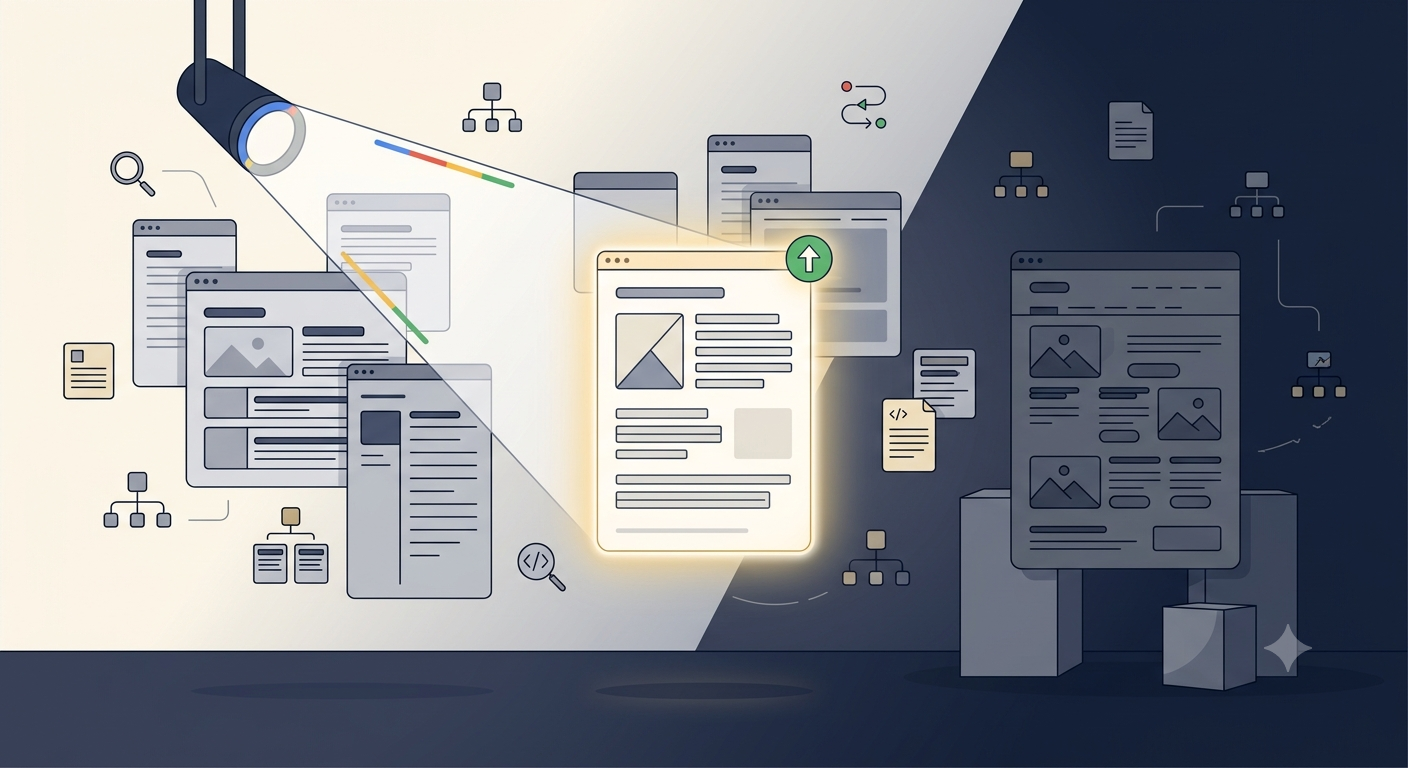
Indexing and ranking are two separate steps in Google's process. Confusing them is one of the most common reasons SEO problems go undiagnosed for months.
According to Google's own documentation, Search works in three separate stages: crawling, indexing, and serving results, and not every page makes it through each stage.
LinkyJuice has audited backlink and indexing patterns across SaaS, e-commerce, and content publishing sites. The diagnostic framework below comes from that work.
Indexing Gets a Page Into Google. Ranking Gets It Chosen.
Indexing is comparable to submitting a resume. Google knows the page exists and has filed it in its system. Ranking is comparable to getting the interview call. Google has compared the page to competing pages and selected it as the best fit for a specific search.
A page can be indexed without ever being selected for ranking. This happens to a large share of indexed pages on most sites.
Google's search process runs in six functional steps: discovery (Google finds a URL, usually through a link or a sitemap), crawling (Google's bots visit and read the page), indexing (Google stores the page in its database), understanding (Google determines the page's topic and audience), ranking (Google evaluates the page against every other page competing for the same query), and visibility (the page appears, or doesn't, in search results). Most SEO advice focuses on the crawling and indexing steps. The ranking step is where most pages actually fail.
Why Some Pages Appear in Search Before Full Indexing Confirms
A page can sometimes appear in search results before Google Search Console confirms it as fully indexed. This is a reporting lag. Search Console reflects a delayed snapshot of Google's data, not Google's real-time understanding of a page.
A page can also begin ranking for narrow, specific queries before it has enough authority to compete for broader ones. A new article about link building might start appearing for a specific long-tail query, such as "link building mistakes for SaaS startups," within a few weeks of publishing. The same page competing for the broad term "link building" typically requires months of additional authority building. The page is indexed in both cases. It is only competitive for the narrower version of the topic.
A page ranking for unexpected long-tail queries but not its main target keyword indicates Google understands the topic but the page lacks the authority or intent alignment needed to compete for the broader term. This is a ranking problem, not an indexing problem.
Why Indexed Pages Fail to Compete
Being indexed means Google has filed a page. It does not mean Google considers the page the best available answer. Three factors determine whether an indexed page actually ranks.
Relevance.
The page needs to match the intent behind a query, not just its keywords. A page titled "How to Build Backlinks" that reads as a definition article will underperform against ranking pages that are tactical, step-by-step guides with templates and outreach scripts, even if the definition article covers the correct topic. The mismatch is in format, not subject matter.
Authority.
A newly published page with no backlinks and weak internal linking has very little authority relative to established competitors. It exists in the index but is not competitive against pages with more relevant links and longer track records.
Trust signals.
A page's competitiveness is relative to every other page targeting the same query. A page can be well-written and still rank on page four if ten competing pages have stronger backlink profiles and more internal support.
If a page shows as indexed in Search Console but generates near-zero impressions, that is almost never an indexing problem. It is a ranking problem: the page is in Google's system, but Google does not consider it a strong match for the queries being targeted.
The Four States of Search Visibility
Pages exist in one of four states, not simply "indexed" or "not indexed":
1. Not discovered.
Google does not know the page exists.
2. Indexed but invisible.
Google has stored the page but has insufficient confidence to display it.
3. Ranking.
Google recognizes relevance and the page is actively competing for a query.
4. Established.
Google consistently trusts and surfaces the page.
Most sites have pages in all four states simultaneously. A content audit typically finds a meaningful number of pages sitting in "indexed but invisible" with no realistic path to ranking without direct intervention.
Where Backlinks Change the Equation
Backlinks do not directly help a page get indexed. Indexing is primarily a function of crawlability and internal linking; a page with zero external backlinks can be indexed quickly if internal links point to it and no technical barriers exist. What backlinks change is whether an already-indexed page can compete.
A page can be fully crawlable, technically clean, and indexed, and still fail to rank, because Google has no external signal to prioritize it over stronger competing pages already occupying top positions. Backlinks from relevant, authoritative sources are that external signal. When those signals accumulate on a page with clear intent alignment, inside a coherent topic cluster, with strong internal links flowing to it, rankings tend to follow.
Authority metrics improving does not guarantee this outcome on its own. In one case, a site added 68 new referring domains in six weeks and its Domain Rating rose from 42 to 57, both signals of growing authority, while its number of top 10 keyword rankings barely changed. Referring domain and Domain Rating growth are indexing-adjacent authority signals; they do not automatically convert into ranking movement without relevance and intent alignment behind them. For a deeper breakdown of this exact pattern, see our guide on Why Your Backlinks Aren't Moving Rankings.
Cluster position matters as much as the link itself. A backlink pointing at an isolated page does less work than the same backlink pointing at a well-connected hub page surrounded by supporting content, since backlinks amplify structure that already exists. This is also why backlink investment should prioritize authority hubs and pillar pages: those pages carry the highest downstream impact, both on their own rankings and on internal link equity flowing to the rest of the site's content cluster. For more on what a well-structured cluster of links actually looks like, see our guide on How to Build a Strong Backlink Profile.
How to Diagnose an Indexing vs. Ranking Problem
If a page is not indexed at all, check these first:
- Is the page crawlable? Look for noindex tags, robots.txt blocks, or password protection.
- Does the page have internal links pointing to it? A page with zero internal links is easy for Google to miss.
- Is a canonical tag pointing to a different URL? If so, Google may be crediting that URL instead.
- Is the page new? Google's own guidance states that crawling a newly submitted page can take anywhere from a few days to a few weeks, and requesting a crawl does not guarantee immediate inclusion.
If a page is indexed but not ranking, this is almost always a relevance or authority problem:
- Does the page's format match the actual search intent? Search the target keyword in an incognito window and check whether ranking pages are how-to guides, comparisons, or definition posts. A format mismatch is often the first problem to fix.
- How strong is internal support? Check whether high-authority pages on the site link to this page, or whether it sits with only one or two weak internal links.
- How does the page compare on authority? A significant backlink gap against higher-ranking competitors is a direct signal. See our guide on Referring Domains vs. Backlinks for how to measure this gap correctly.
- Is another page on the same site targeting the same intent? Multiple indexed pages competing for similar queries split authority between them, a pattern known as keyword cannibalization, and Google ends up choosing between them instead of confidently ranking one.
If a page ranks inconsistently, ranking instability usually signals uncertainty:
- Multiple pages on the same site targeting the same intent produce week-to-week ranking shifts between a site's own URLs.
- Fluctuating rankings often mean Google sees topical relevance but lacks confidence that the page is the best match for the specific query.
- Pages with thin backlink profiles and weak internal support tend to rank inconsistently; rankings typically stabilize as authority accumulates.
Indexing Problem or Ranking Problem? A Quick Checklist
Most "why isn't my page ranking" problems fall into the second list. The fix is stronger relevance signals, better intent alignment, and authority directed at the right pages, not additional indexing effort.
Does This Distinction Apply to AI Overviews and AI Search Too?
The indexed-versus-ranked distinction has a parallel in AI-generated search results. A page being indexed by Google does not mean an AI system will cite it in a generated answer, in the same way indexing does not guarantee a traditional ranking position.
AI systems evaluate credibility and topical authority signals when selecting which sources to cite, and these signals overlap with, but are not identical to, traditional ranking signals. Ahrefs' analysis of 75,000 brands found that branded web mentions correlate with AI Overview visibility more strongly than traditional backlinks do, at roughly a three-to-one ratio. A page can be indexed, ranking, and still receive little to no citation inside AI-generated answers if it lacks the broader brand-mention and topical-authority signals AI systems weigh separately.
Stop Treating Indexing as the Goal
Indexing is the minimum requirement for visibility, not the outcome. A site can have thousands of indexed pages and rank for almost nothing if those pages lack authority or relevance signals, while a smaller site with a few hundred focused, well-linked pages in a tight topic cluster can outperform it.
The relevant question is not whether Google is aware a page exists. The relevant question is whether Google believes the page belongs in front of searchers for a specific query. Meeting that second standard is where the actual work happens.
Frequently Asked Questions
Can a page rank without being indexed?
Not in the traditional sense. A page must be in Google's index to appear in standard search results. Visibility can appear before Search Console reporting catches up, or a page can rank for narrow queries while broader authority signals are still developing, but the page is indexed in both cases.
Why is my page indexed but not showing in Google?
Being indexed means Google has processed and stored the page. It does not mean Google has judged the page competitive for a specific query. Common causes include a mismatch between the page's format and the query's intent, weak authority signals, weak internal linking, or a stronger competing page satisfying the same query more effectively.
Does indexing guarantee rankings?
No. Indexing determines eligibility. Ranking is a separate, ongoing evaluation Google runs each time a query is searched, comparing every eligible page and surfacing the ones it judges best satisfy the search intent.
Do backlinks help pages get indexed?
Indirectly. Backlinks give Google's crawlers an additional path to a page, which can speed up discovery. Indexing itself is primarily a function of crawl accessibility and internal site structure; a page with strong internal links and no technical barriers can be indexed quickly with zero external backlinks. Backlinks matter more for ranking than for indexing.
How long does it take for an indexed page to start ranking?
Timing depends on site authority, competition, and content quality, and typically ranges from a few weeks to several months. A page targeting a low-competition, narrow query can rank faster than the same page targeting a broad, high-competition term.
Should I build links to pages that aren't ranking?
It depends on the underlying cause. If a page isn't indexed, technical issues need to be fixed first. If it's indexed but under-ranking due to weak authority, targeted backlinks can help directly. If the cause is a search-intent mismatch or competition from another page on the same site, those structural issues need to be resolved before link investment, since backlinks amplify existing structure rather than fixing a broken one.
The Difference in One Sentence
Indexing answers whether Google knows a page exists. Ranking answers whether Google believes that page deserves visibility for a specific query.
Find the Visibility Gap
Most pages on an established site are already indexed. The real question is whether Google has a reason to choose them over every other page competing for the same space.
LinkyJuice helps SaaS, AI, and e-commerce brands identify authority gaps and build backlink strategies that strengthen the pages worth ranking. Book a call to find the gap and fix it directly.
About the Author
Davit Nazaretyan writes about link building, backlink audits, and SEO automation at LinkyJuice. His work focuses on separating what actually moves rankings from what just looks like it does: from cleaning up toxic backlink profiles to building outreach systems that hold up against algorithm updates. Connect on LinkedIn.