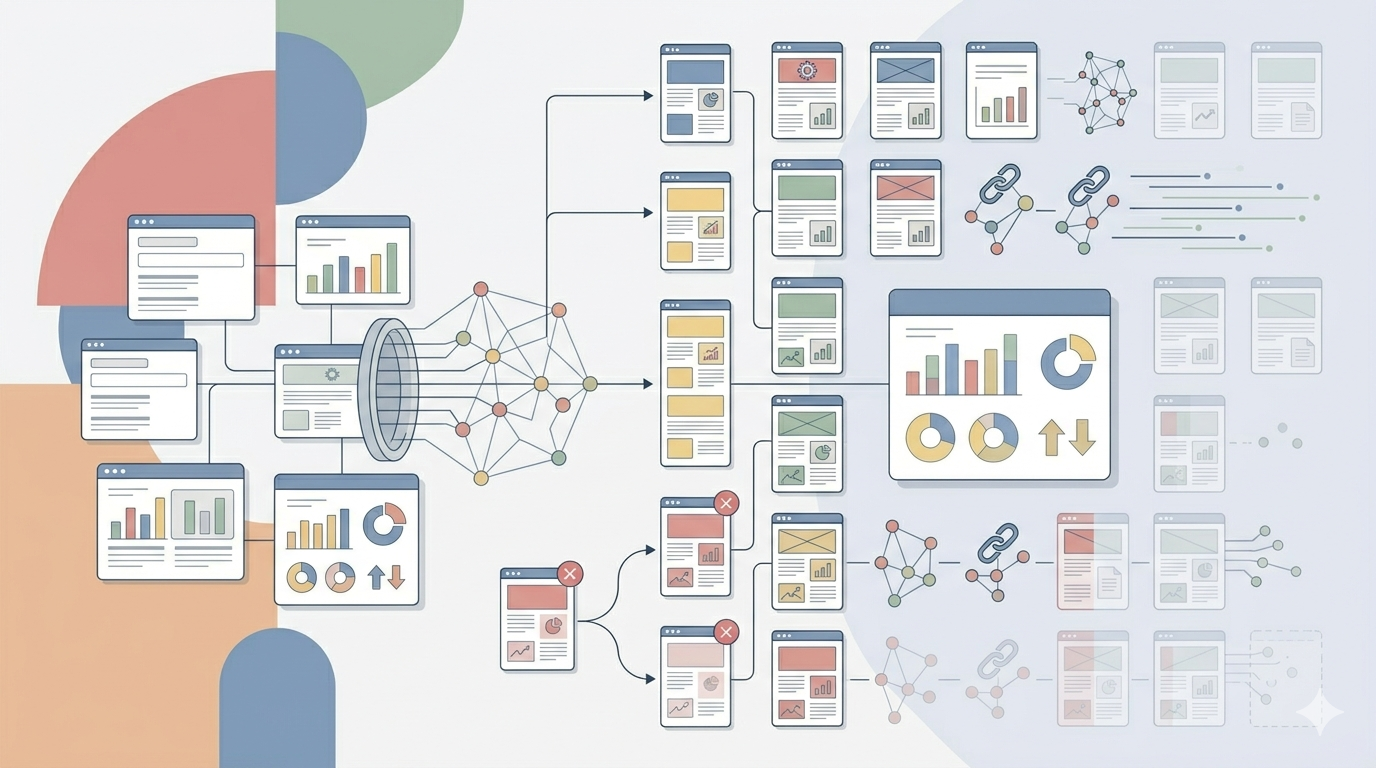
When SEOs say Google "ignores" links, it does not mean the links aren't crawled or indexed. It means the links stop influencing rankings, fully, partially, or not at all, depending on how Google's systems classify them.
What "Google Is Ignoring Your Links" Actually Means
A page can gain dozens of new referring domains and still see rankings hold flat. This is not a rare edge case. It shows up in real audits constantly.
Case Study: Lots of Links, No Movement.
A SaaS site gained 68 referring domains in six weeks, mostly DR40-70 guest posts. Domain Rating went from 42 to 57 in Ahrefs. Indexed pages stayed flat. Organic performance barely moved: top 10 keywords went from 41 to 39, and estimated traffic ticked up from roughly 8.2K to 8.5K, a 3.6% gain against a 36% jump in referring domains. Meanwhile, competitors in the same space lost backlinks, some strong ones, and held or improved their rankings anyway.
The lesson: Google doesn't treat all links as equal currency. Referring domains still correlate with rankings in aggregate, but correlation is not causation at the individual-link level, and a link's type determines how much of that broader correlation it actually contributes to any single page.
How Google Filters Links, Stage by Stage
Google does not publish its exact scoring. Between official statements, patent filings, leaked documentation, and large-scale third-party studies, the filtering process is well understood at a stage level.
Discovery and crawling.
Google finds and indexes the page the link sits on. This stage alone does not affect rankings, it just determines whether Google is even aware the link exists.
Link analysis.
PageRank-style systems evaluate whether the page, and the link on it, carries topical relevance and authority. A link from a page Google considers weak or off-topic carries less analytical weight from this stage forward.
Spam filtering.
SpamBrain, Google's AI-based spam detection system, screens for unnatural link patterns, paid links, and link networks. A flagged link loses most or all of its value at this stage, regardless of the domain's overall authority, fundamentally transforming the future of link building and quality evaluation.
Usefulness scoring.
Whatever survives spam filtering is judged on four factors together, not separately: topical relevance (does the linking page actually match the topic), authority and trust (is the site credible and established), placement (is the link in the main content or buried in a footer or sidebar), and pattern-level signals (does the overall link profile look natural or manufactured).
Google is not counting links. It is sorting them into buckets: some move rankings, some help with discovery and context only, and some get ignored outright.
The 2026 Spam Updates: What Actually Changed
Google ran three spam updates in 2026: March, June, and August. The specifics of each matter more than most SEO advice accounts for.
March 2026 rolled out in under 20 hours, the fastest confirmed spam rollout on record.
June 2026 did not target link spam specifically. Google confirmed that disavowing links would not help sites recover from it. The actual targets were scaled, low-value content and a newly enforced policy against back-button manipulation, first published in April 2026. Google's spam systems now also police AI Overviews and AI Mode, not just the traditional results list, a detail most 2026 SEO coverage has not caught up to yet (closely reflecting how AI search chooses which sources to trust across automated surfaces).
August 2026 was again a general spam update, not a link-specific one. Google has historically included "link" in the update name when backlinks are the direct target, and it was not present this time.
The detail worth building a strategy around: in an actual link spam update, once Google's systems strip the ranking benefit a manipulative link was providing, that benefit does not return, even after the link profile is cleaned up. This is a meaningfully different risk than a link simply being ignored going forward. Aggressive link building does not just plateau when caught. It erases gains permanently.
Why Some Links Move Rankings While Others Do Nothing
The impact of any single link depends on several factors working together, not one variable in isolation. Each one is worth understanding on its own.
Relevance
Links from pages in your niche contribute more than links from unrelated topics, even when the unrelated site has higher authority. A backlink from a well-known general news site about a completely unrelated subject passes far less useful signal than a smaller, on-topic industry blog. Google's systems increasingly weigh whether the linking content and the linked content belong in the same conversation, not just whether the linking domain is trusted in general.
Trust
One editorial link from a respected, on-topic site can outweigh dozens of weak guest posts. Trust here isn't just about the domain's overall reputation, it's about whether the specific page carries genuine editorial judgment rather than being built primarily to host outbound links.
Case Study: Why More Isn't Always Better.
An e-commerce site ran two link campaigns in parallel for 60 days.
Campaign A chased volume: 42 guest post links from DR50-75 sites. DR moved from 38 to 49. Rankings barely responded, 6 new top-20 keywords, 1 new top-10 keyword, traffic up just 4%.
Campaign B chased quality: 3 editorial links from smaller but genuinely relevant publications (DR30-60). DR barely moved. Rankings did the opposite of Campaign A: 19 new top-20 keywords, 11 new top-10 keywords, traffic up 27%. Three editorial links outperformed 42 guest posts by a wide margin. This lines up with independent industry data: in 2026 surveys, digital PR is now rated the single most effective link-building tactic by roughly a third of specialists, nearly double the rate for traditional guest posting, while none of the top-performing practitioners surveyed ranked link exchanges as their most effective method, even though a large share still use them out of habit.
Anchor Text
Exact-match anchors repeated across a link profile read as manipulation to Google's systems. A natural mix of branded, partial-match, and generic anchors performs better than a tightly optimized one. A profile where every link uses the same exact-match keyword phrase is one of the clearest manufactured-pattern signals Google's systems can detect, precisely because it almost never happens organically.
Pattern, Not Just Placement
Google weighs the shape of an entire link profile, not just individual links in isolation. A wave of similar guest posts arriving close together, with matching anchor phrasing and article structure, starts to look manufactured even when each individual link looks fine on its own. This is why a campaign can produce links that each pass a manual quality check and still collectively trigger reduced value, the pattern across the batch is the signal, not any single link within it.
Placement Within the Page
A link inside the main content, in a relevant paragraph, reads as a genuine recommendation. The same link in a footer, sidebar, or author bio reads as structural or promotional, and is weighted accordingly. This is one of the more overlooked factors: two links from the identical domain can carry meaningfully different value depending purely on where on the page they sit.
How to Check If Your Links Are Being Ignored
A few concrete checks can reveal whether a link-building campaign is actually moving rankings or just inflating a report.
Compare referring domain growth against keyword and traffic movement over the same window.
Pull the referring domains graph from Ahrefs or Semrush and the organic keywords/traffic graph from the same tool, set to the same date range. If referring domains are climbing steadily while top-10 (or top-20) keyword counts stay flat or decline, that's the clearest sign a batch of links isn't translating into ranking movement.
Check Search Console for the specific pages receiving new links.
Look at whether those exact pages are gaining impressions and average position for their target queries. Growth in overall site traffic that isn't showing up on the pages the links actually point to suggests the links aren't reinforcing the intended target.
Segment new links by type and check each segment separately.
If a campaign mixes guest posts, niche edits, and digital PR placements, tracking them as one undifferentiated batch hides which type is actually contributing. Tagging links by source type in a spreadsheet against ranking movement over 60-90 days usually makes the pattern obvious.
Watch for a plateau after a strong first batch.
A site that saw meaningful movement from an initial round of links, then far less movement from a similarly-sized second round using a similar link type, is likely experiencing the diminishing-returns pattern described above, not a sign the links themselves are lower quality.
Case Study: Why Link Growth Eventually Stops Working.
A content site built 55 links via guest posts and niche edits in month one, then another 48 with a similar quality profile in month two. Month one: organic traffic up 18%, several mid-tier keywords moving. Month two: traffic up only another 2.1%, zero new top-10 keywords, despite Ahrefs continuing to show DR growth from the new links. The links kept getting counted in third-party tools. They just stopped moving rankings. Once Google has already registered a particular link pattern from a site, additional links in that same pattern add diminishing value, regardless of the metrics they carry.
Beyond Links: The Brand and Entity Signals Google Weighs Now
This is the part most link-building advice still leaves out, and it is the fastest-moving part of the landscape in 2026.
Google increasingly evaluates brands, not just individual pages, using signals like consistent business information, editorial mentions, expert citations tied to real authors, branded search volume, and third-party reviews. This illustrates the hidden role of brand mentions in modern algorithmic trust. A site that only ever invests in backlinks, with no broader footprint, gets treated with more caution by Google's systems.
One nuance worth getting right, because it is widely overstated: unlinked brand mentions are not a confirmed direct Google ranking factor.
Google's John Mueller has pushed back on the popular "implied links" theory built around a 2012 Google patent. Where unlinked mentions demonstrably do matter is AI-driven visibility, being cited or recommended by ChatGPT, Perplexity, and Google's AI Overviews. Ahrefs' research on 75,000 brands found that how often a brand is mentioned across the web correlates with AI Overview visibility roughly three times more strongly than traditional backlinks do (0.664 vs. 0.218). If a content strategy already touches AI search visibility, that is a real reason to invest in earned mentions, just not because it moves classic blue-link rankings directly.
The practical takeaway: pair link building with digital PR, original research, and expert-attributed content that earns brand mentions whether or not every mention carries a link. That combination is what shows up across most 2026 case studies as the thing separating sites that recover rankings from sites that stay stuck despite a growing link count.
Common Mistakes That Are Hurting Your Link Strategy
Treating link building as something you finish.
Links compound when they reinforce a consistent topical focus across the site, not when they are a one-time campaign.
Building links in isolation from the page they point to.
Even strong links underperform on weak, irrelevant, or poorly structured landing pages.
Ignoring internal linking while chasing external links.
Internal structure determines how far the authority from a new backlink actually travels; a link to one article does little if that article isn't connected to the rest of the site.
Assuming link velocity alone signals quality.
Steady, natural-looking growth tends to outperform sudden bursts, even at similar total volumes.
Chasing easy wins like directories and profile links.
These pad link counts without adding real contextual value.
Over-relying on one link type, typically guest posts.
When most of a profile looks the same, its impact flattens over time.
Not aligning links with pages that already have momentum.
Links move the needle more when they support pages already showing some ranking traction, rather than random URLs.
Ignoring technical health.
Slow Core Web Vitals, indexing issues, or crawl problems can quietly cap how much value even a strong backlink profile delivers.
Frequently Asked Questions
Do nofollow links still matter?
Nofollow links typically do not pass a direct ranking signal. They can still drive referral traffic, brand exposure, and discovery, which indirectly supports rankings over time, and they contribute to the brand-mention signals that matter for AI Overview visibility.
Are all high-authority links valuable?
No. Context and topical relevance decide a link's value more than the linking site's raw authority metrics. A high-DR link from an unrelated niche typically underperforms a lower-DR link from a genuinely relevant, on-topic site.
Should I disavow my backlinks?
For most sites, no. Google's own guidance states its systems generally identify and discount low-quality or spammy links without action required. Disavowing will not restore rankings lost to a link spam update specifically, since the benefit those links provided is already gone. Reserve disavow requests for sites with a manual action tied to unnatural links, or a documented negative SEO attack.
How many backlinks do I actually need to rank?
There is no fixed number. Pages with at least one relevant backlink consistently outperform pages with none, but beyond that, quality and topical relevance matter more than any particular count. The e-commerce case study above is a direct example of 3 editorial links outperforming 42 guest posts.
Do unlinked brand mentions count toward rankings?
Not as a confirmed direct Google ranking factor. Google's John Mueller has specifically pushed back on the "implied links" theory. Unlinked mentions matter considerably more for visibility in AI-generated answers, including AI Overviews, ChatGPT, and Perplexity, where Ahrefs' research found branded mentions correlate with AI visibility roughly three times more strongly than backlinks.
Why do some pages get links but still don't rank?
Usually because Google does not see the page as a strong answer to the topic. The page may be thin, off-topic relative to the link's context, or poorly connected to the rest of the site through internal links.
How can I tell if my link-building campaign is actually working?
Compare referring domain growth against keyword and traffic movement over the same date range, using the same tool. If referring domains climb steadily while top-10 or top-20 keyword counts stay flat, the campaign is likely producing links Google is discounting. Checking Search Console for the specific linked pages, rather than site-wide traffic, gives a clearer picture than aggregate metrics alone.
Is link building still worth it in 2026?
Yes, when the links are relevant, trusted, and paired with the brand and content signals described above. Link building as an isolated tactic, disconnected from topical relevance and brand authority, is the approach that has stopped working reliably.
The Bottom Line
Links still matter, but only on Google's terms, aligning directly with broader SEO predictions for the year regarding the death of volume-driven tactics and the rise of topical authority. Three spam updates into 2026, the filtering has only gotten more precise, and the sites still winning pair relevant, trusted links with real brand and topical authority instead of chasing referring-domain counts in isolation.
If a link report looks strong but rankings have not followed, the questions worth asking are: are these links actually relevant to the page they point to, do they fit a natural pattern, and does the rest of the site's authority support what they are trying to do?
If you want help building links designed to actually move rankings, not just inflate a report, that's what we do at LinkyJuice.