One of the hardest things to do in SEO is scaling your link building. It’s easy to get a few high-quality links through direct outreach. But where most people get stuck is in scaling that process without seeing a drop in quality. Whether that’s the outreach starting to feel spammy or the backlink profile looking unnatural, this is a real struggle for a lot of businesses.
In 2026, this is more important than ever because Google now knows how to detect not just the quality of the links, but how they’re acquired. Link building is no longer about getting more links. It’s about building a system that gets links while keeping the quality high.
In this article we’ll show you how to do just that by answering the question, “how do we get good links without weakening what makes them valuable to begin with?”
Where Link Building Breaks Down When You Scale
The biggest cause of failure for link building strategies is poor execution. In other words, when teams start scaling too quickly. That’s when the process stops being selective and starts being about sheer volume.
When the scale is small, the outreach can be very personalized. People or agencies are chosen very intentionally and messages are tailored for them. But when the aim is to reach as many people as possible, three things tend to happen.
One, prospecting becomes a numbers game. You lose sight of relevance and start targeting random sites simply to “hit quota,” regardless of whether they’re connected to your niche (and audience) or not.
Two, the outreach starts to feel generic. You start relying on impersonal templates that are meant to be churned out quickly but fail to resonate or inspire the recipient because they’re not targeted anymore. These messages no longer hit the pain points or pitch to the goals of the recipient.
And three, success starts being measured by the amount of links, not the quality. If you’ve been in the SEO business for even a short while, you know that it’s not the number of raw links that moves the needle, but the relevance and authority of the links.
This is where SEO teams see a big mismatch between their input and output because despite all these new backlinks that they got, there is no movement in visibility. And in some cases, there’s actually a decline.
Relevance is the first thing you must protect
When scaling is done the wrong way, relevance is usually the first thing to go.
These days, relevance is not just how similar your topic is to the search query. It’s about how well the content, audience, and search intent match. In other words, is the link contextually aligned with the page it’s sitting on?
A link from a highly relevant, smaller site will outperform one from a popular but irrelevant domain. Search engines look at the content of the referring domain to understand the backlink. If there’s no connection, they can’t “interpret” its value (and won’t “recommend” it, as a result).
On top of that, if users don’t engage with your link because it feels out of place for them, it’s deemed less helpful by search engines, which can reduce your visibility.
The solution here is not to minimize your outreach, but to make it selective. Instead of sending bulk messages to whoever, narrow your focus to domains that are topically aligned.
For example, instead of going after “marketing blogs,” you can narrow it down to “blogs about link building,” or “technical SEO resources.” This way your scaling hits both notes: volume AND relevance.
Outreach quality drops when you scale messages, not strategy
Most teams assume scaling outreach means sending more emails. In reality, it means splitting your prospects into segments.
So instead of having one huge list of “websites to message,” you should divide it into micro-categories based on factors like content type, user intent, domain authority, and topical category.
Each group then gets slightly different messaging. We’re not talking about completely different emails, just different approaches to convey why the link would be relevant to them specifically.
This kind of thinking leads to higher response rates at scale. It also helps maintain backlink quality as you grow, since generic backlinks tend to be lower quality.
Anchor text and link patterns must stay natural
The more you scale, the more you develop a pattern, and that’s exactly what search engines look for.
When you’re focused on getting as many backlinks as possible, you might fall into the habit of over-optimizing your anchor texts, using the same phrases or words over and over again. When your backlink profile has too many keyword-rich anchors, it starts looking overly-curated and forced, instead of natural.
A healthy profile should include a healthy mix of different types of anchor texts. From branded anchors and partial match ones, to generic phrases, contextual terms, and the occasional exact match keywords.
The same can be said about how quickly you acquire these links. If the number of your backlinks suddenly spikes overnight, that might be flagged as manipulation and cause you more harm than good.
A good rule of thumb is to think of scaling in terms of patterns, not individual links. Google certainly is.
Monitoring is what keeps scale from becoming chaos
Without monitoring, scaling becomes this unpredictable guesswork that may or may not be replicable. We also have to account for the margin of error because the more links we have, the harder it becomes to track which links are still alive, which domains are useful, and which anchors are repeated. Additionally, it might be unclear whether the links you have are actually improving ranking or just inflating metrics.
This is why you need link tracking tools to take out the guesswork for you and handle the bulk of the process. They’re good for not just reporting, but also for analysis.
The best scaling systems monitor their activity to understand how to better target their outreach, check the performance of backlinks, and understand which domains need to be prioritized (or cut altogether).
Scaling without feedback is like throwing things against a wall to see what sticks. Scaling with feedback is optimization.
How Scalable Link Building Systems Actually Work
Scaling starts with systems, not outreach
In 2026, scaling doesn’t mean just doing more. It’s about making better decisions consistently.
Instead of focusing on sending more outreach emails, it’s smarter to break down the process into steps and do more of that.
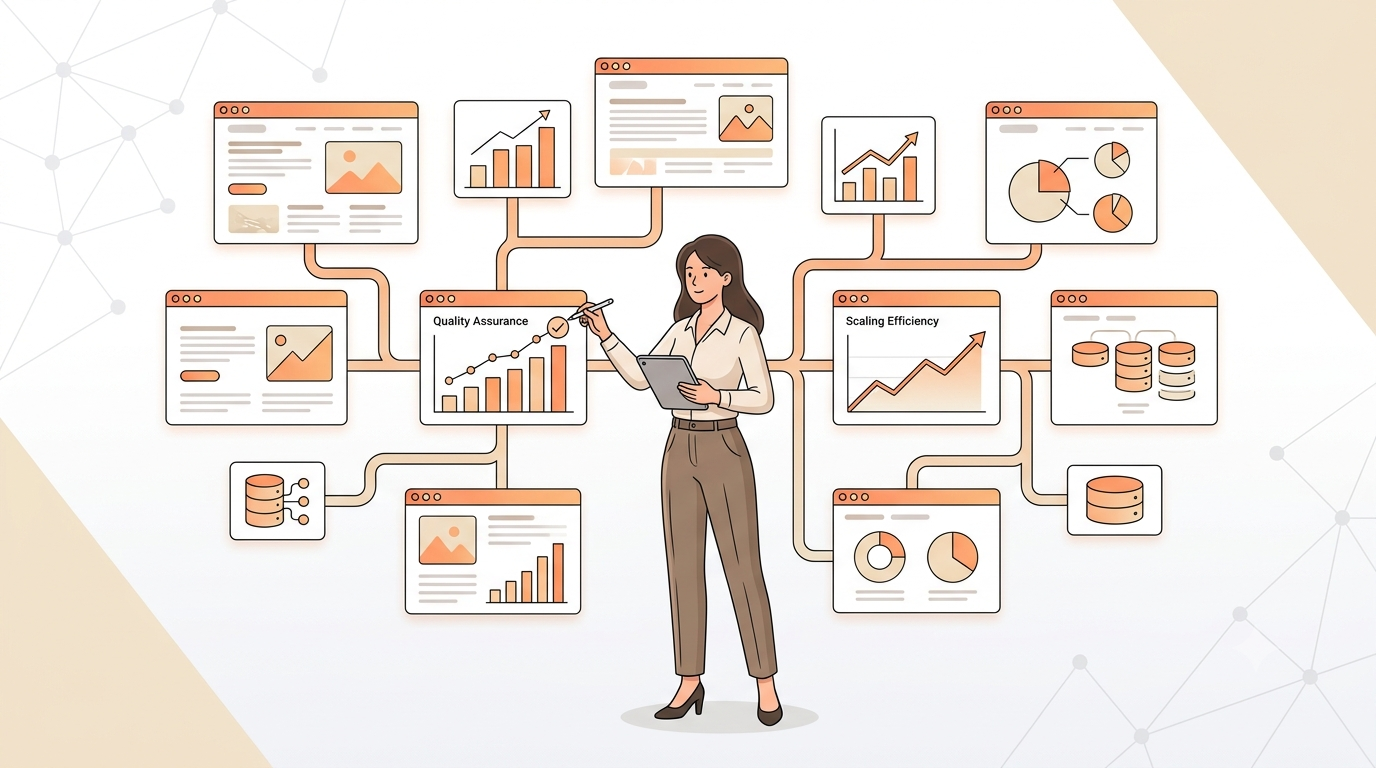
Scaling is made up of four key steps:
- Find the right targets (websites, pages, domains)
- Decide which ones are worth it (authority and relevance to your niche)
- Reach out to them (send customized messages)
- Track what works (monitor and analyze how your efforts are doing)
By approaching scaling this way, none of your efforts are random. They become highly targeted and backed by actual data.
Use Competitor Backlink Analysis to Scale Smarter
One of the fastest ways to scale your link building securely and without losing quality is to observe what your competitors are doing.
High-performing SEO teams don’t need to start from scratch and invent the wheel. They simply reverse engineer competitor backlink profiles to discover proven strategies that they can use for their own brands.
By understanding the backlink data of others in your niche, you are studying what type of pages attract the most backlinks (guides, free resources, research, etc.), which tactics are working right now, and which websites link to the same type of content. And with that information, you’ll uncover the gaps in your strategies (and how to close them).
This approach helps you move from guesswork to pattern recognition.
Identify link opportunities with competitor research tools
This process may sound daunting at first. I mean, if you’re trying to streamline your process and scale your business, this sounds like piling on more work. Well, luckily, there are plenty of tools out there that can do the work for you.
For example, you have sites like Ahrefs, Semrush, Moz, and SpyFu that can analyze backlink profiles for you. They provide in depth feedback about potential opportunities for you based on relevance, authority, and link type.
One of the most important features you can use is the link intersect tool, which shows you which websites link to competitors but not to you. These domains are golden for you because they’ve already shown a high-probability willingness to other websites within your niche. So chances are, they’ll link to yours as well.
This helps you avoid the hassle of building a contact list from scratch and go through a trial and error process and just target a pre-vetted list of relevant prospects. That is a fool-proof way of expanding your outreach.
Reverse engineer what actually earns links
In addition to finding domains, studying competitors’ backlink profiles helps you understand why they’re getting links.
For example, you might discover that your competitors get the most links through their data-driven content. Maybe certain types of posts like roundups or stat pages attract more links, or you might find that certain topics are angles just do better in your niche.
This is the kind of information you need to be able to replicate the patterns of your peers. The key here is that you’re not copying their content, you’re understanding why they worked in the first place.
Remember: you’re not just building links. You’re building content that attracts them.
Turn competitor insights into scalable workflows
After you understand why their content is doing well, it’s time to integrate that information into your link building system.
You can start by creating a list of prospective sites based on what you found in the competitor backlink profiles. Front that list, prioritize the domains that link to similar sites in your niche.
Next, create content that seems to be earning the greatest number of links. In other words, replicate the linkable formats you’ve seen in competitors, while putting your own spin on it.
Use this data to inform your outreach campaigns. Completely restructure your efforts to focus on the right sites, the right content, and the right timing.
And finally, have this be a core part of your system. This is not a one-and-done strategy. It’s meant to be an ongoing part of your strategy that should be tended to refine your approach. Treat it like a feedback loop where information from your competitor research improves your targeting and content creation.
Create Linkable Assets That Scale Naturally
A golden rule of business is to create a product that sells. The same applies to link building strategies. It’s smarter to create content that naturally attracts links. Instead of focusing solely on outreach, successful SEO experts work to create linkable assets, content that is designed to earn backlinks.
Consider this step a foundational part of your link acquisition because it invites other sites to link to your content without you needing to ask them.
The most common linkable assets are:
- Free tools or resources like templates, widgets, calculators, etc.
- Original research or studies with actual data
- Infographics or visual assets
- Expert opinions or reviews
- Evergreen content that uses the skyscraper technique
For example, original research tends to attract consistent backlinks over time because it acts as a reference point for other content.
For example, original research tends to generate consistent backlinks over time because it becomes a reference point for other content. Another one is the “10x content,” content that’s ten times better than what already exists naturally gets links through its value, not forced outreach.
The idea is to create reusable content assets that can be utilized across different link building campaigns. That’s how you get the most out of your efforts. Instead of building links, you’re creating content that attracts them.
This is one of the smartest ways to scale your link building, while maintaining the quality you’ve set for yourself.
Use automation without removing the human touch
Automation often gets looked down on in this industry. It’s considered risky and unreliable. The truth is it can be ineffective and even harmful, if used wrong.
If it’s used poorly, it can lead to poor backlinks and spammy outreach that gets no responses. On the flip side, however, if it’s used strategically, it can cut down on time spent on repetitive tasks.
Automation is designed to streamline execution, not decision making. Scaling doesn't mean mass-blasting inboxes. To do it safely, you have to understand the automation trap and why manual editorial judgment is still the most valuable part of the workflow.
It’s best used for:
- Prospect discovery
- Email finding and verification
- Initial list segmentation
- Follow-up scheduling
- Reporting and tracking
That said, it should not be used for:
- Choosing which prospects to message
- Composing the outreach messages
- Deciding the relevance of each domain
- anchor text strategy
Like we said, you’re not automating link building itself, just parts of the process. You still need to be the one overseeing everything.
How to Apply This in Real Link Building Campaigns
Diversify Your Link Building Strategies
One of the biggest risks when scaling your link building is relying too heavily on one kind of strategy. If all your backlinks are coming from the same tactic (e.g., guest posting or outreach), your backlink profile becomes predictable.
In 2026, to have a truly healthy backlink profile, it’s important to diversify your efforts. This means trying different approaches like:
- Guest posting on relevant industry sites: find domains that fit your niche and contribute to their content.
- Broken link building: find broken links on other websites (pages that no longer work) and suggest your content as replacement.
- Resource page link building: look for pages that list useful resources and suggest they add your site in that list.
- Digital PR and thought leadership campaigns: create content like research, tools, or stories that journalists would want to cover.
- influencer outreach and collaborations: find content creators who have enough relevance and authority, and pitch to them.
- Visual content outreach: create shareable assets like infographics, charts, or original images.
- Niche listings: get your site on niche-specific directories.
By using these different link building strategies, you get different types of links, from citations and mentions to editorial backlinks and contextual placements.
Diversification is great not just for scaling your backlinks but also for improving your backlink profile health because a varied profile is one that looks natural.
Reclaim Lost Links and Capture Easy Wins
Not all scaling is about reaching out to new prospects. There’s a missed opportunity here for targeting or rather reclaiming links you’ve already earned, or should have.
Link reclamation is a great way to scale your backlink profile while maintaining quality. You can do this in a number of ways. For example, you can recover broken backlinks. These are links that point to pages that are either deleted or outdated.
You can also find brand mentions that have no links and ask that they link to your site. All you’d have to do is send a simple outreach message and get a backlink.
Or you can fix links that go through multiple redirects so they don’t lose their value.
Finally, one of the most popular methods is the skyscraper technique, which is when you find a page with outdated content and replace it with your own.
There are a lot of SEO tools out there that can show you these missed opportunities for backlink reclamation by tracking referring domains, lost backlinks, and mentions across different platforms.
The Real Goal: Predictable Authority Growth
If we zoom out, scaling is about predictability.
A strong system produces consistent outcomes you can rely on. For instance, it should be able to produce stable growth in referring domains and steady improvements in topical authority. And most importantly, it should be able to reduce dependency on a singular strategy or tactic.
When scaling is done properly, it stops feeling like growth hacks and starts feeling like building a system. That’s the shift modern SEO teams are aiming for in 2026.
Final thoughts
Scaling link building (successfully) is less about finding the perfect tools and speeding up results and more about designing a system that produces consistent, high-quality links over time.
When relevance is built in, automation is built into the system, outreach is split into smaller categories, and performance is tracked, scaling stays sustainable.
Without these practices, scaling becomes about accumulating numbers, not impact.
The difference between the two is how the system is built.
If you want help setting up a system like this and actually scaling link building in a way that doesn’t break quality, you can book a call with LinkyJuice and we’ll walk through it with you.