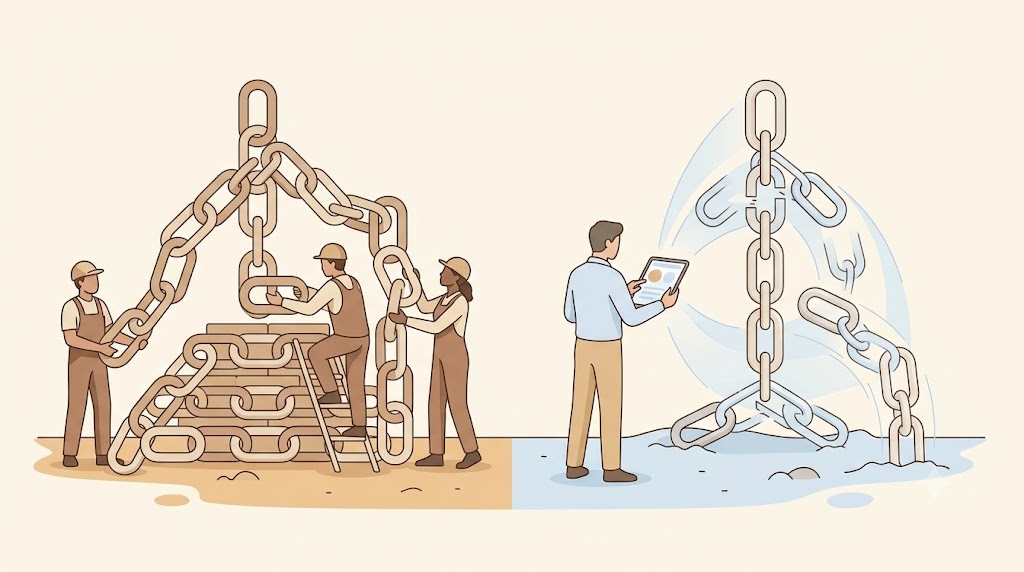
When businesses start thinking about getting more visible online, they usually hit the same wall: should we do traditional link building or digital PR?
Most people aren't even sure what either of those things actually means. So let's start from zero, explain both in plain English, and figure out which one makes sense for where you are right now.
What Are We Even Talking About?
Think of the internet like a popularity contest. When other websites link to yours, it's like getting a vote of confidence. The more votes you get from credible sources, the more Google trusts your site and shows it to people searching for things you offer.
Traditional link building is the process of going out and actively collecting those votes. You reach out to bloggers, websites, and online directories and ask them to link back to you. It's structured, repeatable, and follows a pretty simple loop: reach out, get a link, see your rankings improve. Not glamorous, but it works.
Digital PR takes a completely different approach. Instead of asking for votes, you create something worth voting for. That might be an original study, a surprising statistic, or a timely story, and then you pitch it to journalists and publications. If they find it interesting enough to write about, they link to you naturally as part of their coverage. You earned the vote instead of asking for it.
The core difference is intent. With traditional link building, you're asking "where can I get a link?" With digital PR, you're asking "what would a journalist actually want to write about?" That one shift changes pretty much everything.
What Each One Actually Gets You
Let's say you're a mid-sized software company just starting to get serious about showing up in Google. Traditional link building is usually where businesses like that begin.
Done well, it builds a solid foundation, and the results are real. One of our SaaS clients started at a Domain Rating of 11 with just 10 ranking keywords. Nine months later, using guest posting, broken link building, and the skyscraper technique, they were sitting at a Domain Rating of 61, ranking for 208 keywords, and pulling in around 19,000 monthly visitors, up from about 1,000. Another client, in the communication SaaS space, saw an 199% traffic increase and nearly doubled their keyword count in eight months. (See our [Social Media Ads Tool case study] and [Communication SaaS case study] for the full breakdown.)
The catch? It doesn't do much for your actual brand. People might find you through Google, but they're not talking about you, sharing your name, or looking you up directly. You become more visible in search results without becoming more recognized in your industry. It's like getting more foot traffic through a side door while nobody knows your name.
Digital PR works differently. Imagine your company publishes a study about something genuinely interesting in your industry, built from data you actually collected. Your team pitches that story to journalists. A major publication picks it up, writes about it, and links to your site as the source.
Now you're not just ranking better. You're getting traffic from people who read that article and wanted to know more. Your brand is showing up in places your audience already trusts. And here's the part that surprises most people: readers start searching for your company by name because they saw it somewhere and remembered it.
That's when digital PR stops being just an SEO tactic and starts building something more valuable: actual brand recognition. It's the difference between being listed in a directory and being mentioned in an article someone actually read and remembered.
The Honest Trade-offs
Traditional link building is appealing for a simple reason: it's predictable. The costs are manageable, the process is straightforward, and you can estimate your results without too much guesswork. For businesses with tight budgets or limited bandwidth, that feels safe. And it is, at least for a while.
The problem is it tends to slow down over time. The best websites to reach out to get picked over. You have to work harder for smaller gains. It's a bit like fishing in a lake that gets more crowded every season. You're still catching fish, but it takes longer and the good spots are harder to find.
Digital PR flips the whole model. Instead of steady and predictable, it's uncertain but potentially much bigger. A proper campaign requires real investment: original research, creative assets, media outreach, and often a team of people coordinating together. And some campaigns simply don't land. You do all the work, pitch the story, and nobody bites. That's a real possibility you have to be comfortable with.
But when it works, the returns are in a completely different league. One successful campaign can earn you links from major publications, send a flood of new visitors to your site, and permanently associate your brand with a topic your audience cares about. Those effects build on each other over time in a way that collecting links one by one just can't replicate.
So the real question isn't which one is cheaper. It's whether you want safe, steady progress or uncertain but potentially game-changing results. That mostly depends on where your business is and how much risk you can comfortably absorb.
Why Your Industry Matters More Than You'd Think
Not every business is in a position to do digital PR, and that's completely fine.
A B2B software company just getting off the ground usually doesn't have the brand recognition or the interesting angles to make journalists care yet. For them, traditional link building is the right starting point. It builds the credibility that makes everything else possible down the road. Our [JobSage case study] and [AI Powered Writing Tool case study] are both good examples of that early-stage approach in action.
But a consumer brand in fashion, travel, finance, or health? Those industries have natural stories to tell and journalists who already cover them closely. Digital PR can start working earlier because the conditions are already there.
It's less about which strategy is universally better and more about which one fits your situation right now.
Not All Links Are Worth the Same
Here's something worth understanding: a link from a major news site and a link from a small random blog are not equal. Not even close. It's like the difference between a recommendation from a well-known expert in your field versus a stranger on the street. Both are technically endorsements, but one carries a lot more weight.
Traditional link building tends to produce a mixed bag. Some links are strong, some are decent, and some don't move the needle much at all over time.
Digital PR, when it lands, tends to produce links from places that carry real weight: established publications, trusted news sites, and editorial content that already has an engaged audience. Those carry much stronger signals to Google that your site is worth paying attention to.
And Google has gotten increasingly good at telling the difference between a link that was placed deliberately and one that was earned because a journalist genuinely found your content valuable. That distinction matters more and more as time goes on.
The Smartest Approach Uses Both
The businesses that tend to win long term aren't choosing one or the other. They're layering both, just in the right order.
Traditional link building lays the groundwork: steady authority growth, keyword ranking improvements, and a solid technical foundation. Think of it as building the roads.
Digital PR builds the reputation on top of that: the media mentions, the brand recognition, the trust signals that tell Google you're not just a website but an actual recognized name in your space. Think of it as getting people to actually want to travel those roads.
Content ties them together, turning the authority you've built into real traffic and revenue. When all three work together, they reinforce each other instead of pulling in different directions.
How Do You Know If It's Working?
Rankings are a decent starting point, but they're not the whole picture.
The things really worth tracking are whether your overall traffic is growing, whether visitors are actually doing something when they land on your site, whether more people are clicking your results in Google, and crucially, whether more people are searching for your brand by name over time.
That last one is a big deal. When branded searches start going up, it means your visibility is turning into genuine recognition. People aren't just stumbling across you anymore. They're looking for you specifically. That's when you know something is really working.
The Risks Worth Knowing
Both approaches carry risks, just different kinds.
With traditional link building, the danger is in doing it sloppily or too aggressively. If your links look unnatural or manufactured, Google can penalize your site and your rankings can drop. It's like cutting corners on a building's foundation: fine until it isn't.
With digital PR, the risk is more about unpredictability. Campaigns can fail to get coverage. Journalists might not find your story interesting. You're depending on other people's editorial decisions, which you don't fully control. It's a higher-variance game.
Neither is risk-free. But knowing which kind of risk you're dealing with helps you plan smarter.
What's Actually Working Right Now
A few things are becoming clear across the industry.
Original data is one of the most reliable ways to earn links right now. Studies, surveys, and interesting findings give journalists a concrete reason to write about you. Jumping on breaking news quickly with a relevant expert opinion is also picking up steam. And consistently sharing genuine expertise in public, through articles, interviews, and commentary, is increasingly influencing how Google evaluates whether a brand is trustworthy.
The bigger shift is that SEO is moving away from just collecting links and toward building a real, recognizable presence in the corners of the internet your audience actually trusts.
Frequently Asked Questions
What is the main difference between link building and digital PR?
Traditional link building is an active, outreach-driven process focused on acquiring relevant backlinks to build SEO authority. Digital PR focuses on creating newsworthy stories, research, or assets to earn media coverage and natural editorial links from major publications.
Which is better for a new website: link building or digital PR?
Traditional link building is generally better for new websites because it provides steady, predictable authority growth. Digital PR requires existing brand recognition or a compelling angle that journalists will care about, making it more effective once a foundation is built.
Can digital PR replace traditional link building entirely?
Usually no. While digital PR earns high-value media links, it is unpredictable and harder to scale on a monthly basis. Most mature SEO strategies combine traditional link building for steady foundations with digital PR for major visibility spikes.
How long does it take to see results from digital PR vs. link building?
Timelines vary depending on where a site starts, but here's what it's looked like for our own clients: one client went from a Domain Rating of 0 to 19 with a 25,246-visitor traffic increase in just two months. Another saw a 178% traffic increase and 171% growth in ranking keywords over seven months. Movement usually starts within the first month or two, and compounds from there. Digital PR can produce immediate referral traffic and brand spikes if a story is picked up, but campaigns require more upfront creation time before that first placement lands.
Do digital PR links pass more SEO value than traditional links?
Links from major news publications and trusted editorial sites carry high authority signals. However, topical relevance still matters: a contextual link from a smaller, niche industry blog can sometimes drive better keyword rankings than a broad, unrelated news feature.
How do I know if my digital PR campaign was successful?
Success goes beyond just counting backlinks. Look for increases in organic traffic, growth in brand mentions, referral traffic from the covering publications, and, most importantly, a noticeable rise in branded searches in Google Search Console.
Can I do digital PR without a PR agency?
Yes, though it requires dedicated time for pitching journalists, building media lists, and developing original data or research. Many businesses start with traditional link building in-house and partner with specialized agencies once they have the budget for full-scale PR campaigns.
Conclusion
Traditional link building strengthens the structure of your site. Digital PR strengthens its reputation. And in today's world, your reputation is what determines how far your structure can actually take you.
The strongest strategies don't treat these as opposites. They use both, in the right proportion, based on where the business is and what it actually needs right now.
Because SEO doesn't just reward the site with the most links. It rewards the brand that has built the most trusted presence across the web.
Book a call with LinkyJuice and we'll help you figure out the right mix for where you are, and build from there.
About the Author
Davit Nazaretyan writes about link building, backlink audits, and SEO automation at LinkyJuice. His work focuses on separating what actually moves rankings from what just looks like it does: from cleaning up toxic backlink profiles to building outreach systems that hold up against algorithm updates. Connect on LinkedIn.