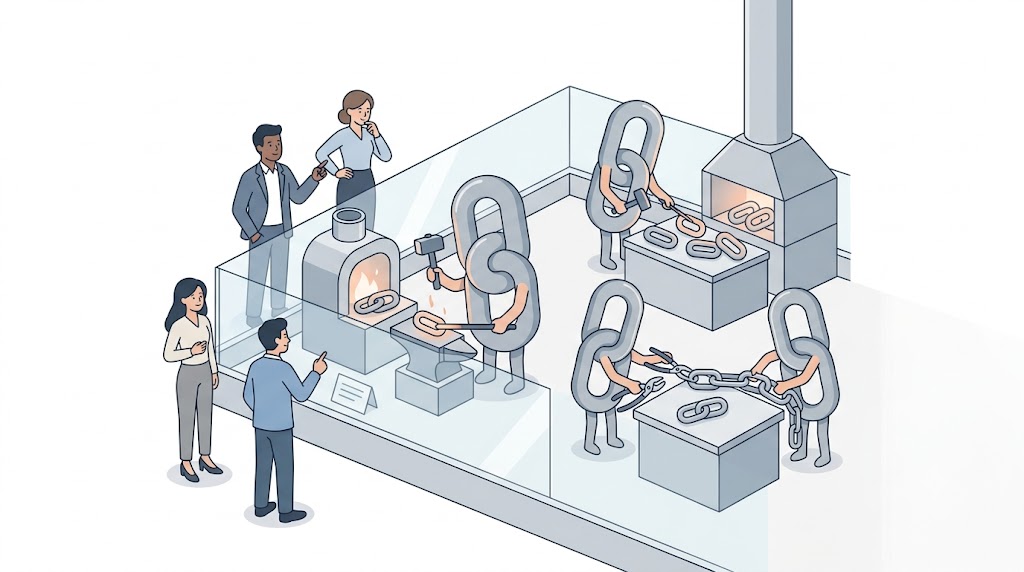
Links remain an important part of Google Search. Google's link-analysis systems, including PageRank, use relationships between pages as part of its ranking and discovery systems.
Top-ranking pages tend to carry several times more backlinks than pages ranked just below them. The number of unique referring domains linking to a page correlates with rankings more strongly than the total backlink count does. Ten links from ten different websites carry more ranking value than ten links from one website.
Backlinks can function as endorsements, though not always. Multiple credible, independent references generally carry more weight than a single one.
What Is a Backlink?
A backlink is a hyperlink on one website that points to a different website. If Site A links to Site B, Site B has received a backlink from Site A.
Backlinks are external links by definition. A link from one page to another page on the same website is called an internal link, not a backlink.
A natural backlink is placed by another site because the content was useful or worth referencing. A manipulated backlink is bought, exchanged, or placed specifically to influence rankings. Google's spam-detection systems are built to distinguish between the two.
Backlinks can drive referral traffic, but their primary SEO value is the trust signal they send to Google, independent of clicks. A backlink that receives zero clicks can still improve rankings. An unlinked brand mention, one with no hyperlink at all, can still improve AI visibility.
How Google Processes Backlinks
Google discovers backlinks through crawling. Automated programs called crawlers follow links from page to page across the web. When a crawler finds a link pointing to a website, it records that connection in Google's index.
Google's index maps the relationships between pages across the web. Google's ranking systems use this map to evaluate how other sites regard a given page.
Not all backlinks carry equal weight. A link from a major, established publication generally carries more weight than a link from a low-traffic, newly created blog. Source credibility is a primary factor in how much weight a backlink carries.
Google-Confirmed vs. SEO Interpretation
This distinction matters more than it might seem, since a lot of backlink advice blends the two without saying which is which.
Google-confirmed:
- Links help Google discover new pages.
- Links are used as a relevance signal.
- PageRank remains part of Google's core ranking systems.
- There is no magical ideal number of links.
SEO industry interpretation:
- Relevant, editorial links are generally considered more valuable than unrelated ones.
- "Link equity" is a useful shorthand for potential value transfer between pages, not a literal, published Google formula.
- Rapid link growth alone isn't proof of manipulation (context and intent matter more than velocity).
How Backlinks Affect SEO
Backlinks affect SEO in four distinct ways.
Authority Transfer (Link Equity)
SEOs often describe the potential value transmitted through links as "link equity" or "link juice." This is useful shorthand, but Google's actual ranking systems are considerably more complex than a fixed amount of authority being divided evenly among a page's outgoing links — treat this as a simplified mental model, not a documented formula.
A link's authority value is generally influenced by the trust level of the linking site, the context and number of other links on that page, and whether the link is set up to be followed by search engines. A link from a well-respected industry publication typically carries more weight than a link from an unknown, low-authority site.
Relevance
Google evaluates whether the linking site is topically related to the linked site. A cooking blog linking to a recipe website is topically relevant. That said, an irrelevant backlink isn't automatically a problem or a penalty trigger. Google's spam concerns focus on patterns of links created primarily to manipulate rankings, not simply a link from an unrelated site existing on its own.
A backlink profile made up of finance sites, news outlets, and money-related publications reinforces a personal finance site's topical authority in that space.
Trust Building Over Time
A single strong backlink helps rankings. Multiple backlinks from reputable, diverse sources help rankings more.
Link volume alone does not reliably predict ranking results. In one LinkyJuice campaign for an online courses SaaS client, shifting strategy from volume (15–20 links per month) toward higher-DR, more selective placements took Domain Rating from 10 to 52 over several months, with organic keywords growing from 55 to over 100 in the same window. Relevance and source quality drove the result, not link count alone.
Helping Google Find New Pages
Backlinks help Google discover content faster. When an established site links to a newly published page, Google's crawlers are likely to find and index that page quickly. A backlink from an established site can speed up indexing for new sites and new pages.
How to Evaluate a Backlink Before You Pursue It
Before spending time or resources chasing a specific link opportunity, run it through six questions:
- Relevance — Does the linking page genuinely relate to your destination?
- Audience — Would its readers actually benefit from your page?
- Purpose — Is there a natural reason for the author to reference you?
- Editorial context — Is the link part of the actual content, rather than a template, footer, or artificial placement?
- Source quality — Is the publication or site itself credible and useful?
- Acquisition — Are you earning the link because the resource deserves it, or manufacturing it primarily for rankings?
The simplest test: if Google didn't exist, would this link still make sense to a reader?
How Backlinks Affect AI Visibility
Some of what follows is observed correlation, and some is a reasonable but unproven hypothesis about mechanism. AI tools read the full context of the content they process, not just individual links, and appear to use that context when deciding which brands and sources to cite in an answer — but exactly how individual AI systems weigh backlinks, mentions, and co-citations internally isn't publicly documented.
For AI visibility, the credibility and topical relevance of a mention appears to matter more than whether the link is a standard (dofollow) link or a nofollow link. A credible, relevant mention can improve AI visibility whether or not it passes traditional SEO link authority. This differs from traditional SEO practice, where the dofollow attribute has historically been the primary target for link builders.
Co-citation is the term for a related effect: when a brand appears repeatedly in the same articles, roundups, or comparison lists as other recognized brands in its category, some research suggests this may help AI tools associate that brand with the category, regardless of whether each individual mention is linked.
Two questions are worth asking before pursuing a mention specifically for AI visibility:
- Does this mention place the brand alongside other brands it should be associated with?
- Would this mention be worth earning even if it carried no link at all?
A mention that satisfies the second question is worth pursuing regardless of its SEO link value.
What Makes a High-Quality Backlink?
A high-quality backlink is generally relevant to the linked site's topic, comes from a credible domain, is placed editorially rather than mechanically, uses varied and descriptive anchor text, and comes from one of many different referring domains rather than a repeated source.
Domain Authority
A link from a well-known, widely trusted site carries more ranking weight than a link from a small, obscure site. Tools like Ahrefs, Moz, and Semrush estimate this with metrics such as Domain Rating and Domain Authority. These are third-party estimates, not Google's actual internal scores.
Relevance
A link from a site within the linked site's niche generally outperforms a link from an unrelated industry, for both SEO rankings and AI visibility.
Placement
A link placed naturally within the body of an article carries more value than a link placed in a footer, sidebar, or templated section.
Anchor Text
Anchor text is the clickable text of a link. Descriptive, varied anchor text gives Google useful context about the linked page. A backlink profile in which most links share the same keyword-heavy anchor text looks manipulated to Google's systems.
Link Attributes: Dofollow, Nofollow, Sponsored, and UGC
A standard link, commonly called a dofollow link, passes link authority to the linked page by default. A rel="nofollow" attribute signals Google to treat the link as an optional hint rather than a hard ranking rule; some nofollow links still carry marginal ranking value.
A rel="sponsored" attribute should be applied to paid placements and affiliate links. This attribute discloses the link's paid nature and prevents it from improperly passing link authority. An undisclosed paid link using a standard dofollow attribute violates Google's link spam policies.
A rel="ugc" attribute flags links inside user-generated content, such as forum posts and comments. These links carry limited direct ranking authority but can still contribute to brand visibility.
A healthy backlink profile includes a natural mix of all four attribute types. A profile made up entirely of one attribute type is a signal Google associates with manipulation.
Referring Domain Diversity
Fifty links from fifty different domains carry more ranking value than fifty links from a single domain, the core distinction covered in referring domains vs. backlinks. Google treats additional links from an already-linking domain as adding little incremental value.
Referring domain growth alone doesn't guarantee ranking gains either. DR is a proxy for backlink profile strength, not a guarantee of ranking movement; relevance and source quality determine whether new domains actually translate into keyword growth, not the domain count itself.
Types of Backlinks
Editorial links are links placed by another site because the linked content was genuinely useful, with no outreach, payment, or arrangement involved. This is the highest-value backlink type.
Guest post links are links earned by writing an article for another site in exchange for a link back. Guest posting on a small number of relevant, high-quality sites is a legitimate strategy. Guest posting at scale purely to accumulate links is treated as manipulation by Google, and its ranking impact tends to diminish as the volume grows.
Resource page links come from curated pages that compile references on a topic, such as "best tools for freelance writers." A well-maintained, relevant resource page listing is a solid contextual link.
Directory links vary in value based on editorial standards. A curated, selective industry directory is worth pursuing. A generic directory that accepts any submission adds little value and can carry risk.
Forum and UGC links come from comment sections and community threads. These links are almost always nofollow or tagged ugc and carry limited direct ranking authority. They can still drive traffic and contribute to brand visibility.
PR and media links come from being quoted or mentioned in news articles or industry publications. These links combine strong authority, high relevance, and low replicability, and they are among the strongest signals for AI visibility as well as rankings.
Sponsored links are paid placements. Google requires these to carry a sponsored or nofollow attribute; an undisclosed paid dofollow link violates Google's guidelines.
Unlinked brand mentions occur when a site names a brand or product without linking to it. These mentions don't pass link equity, but they contribute to topical association and AI visibility. An unlinked mention can often be converted to a full backlink by asking the author to add one.
How to Build Backlinks
The foundation: useful, original content.
Original research, detailed guides, free tools, and unique data sets give other sites a genuine reason to link.
Outreach.
Proactively contact relevant websites and suggest your content as a resource. Genuine relevance and a low outreach volume improve response rates.
Broken link building.
Find links on other sites that point to dead pages, then suggest your own content as a replacement. Effective because it solves a real problem for the site owner.
Digital PR.
Create data or stories that journalists and bloggers want to cover. A well-researched study with a surprising finding can earn links from many outlets simultaneously, and also produces the kind of co-citation coverage that supports AI visibility.
Unlinked mention reclamation.
Find existing unlinked mentions of your brand and ask the author to add a link. Because the author already knows and has written about the brand, this method has a higher success rate than cold outreach.
Competitor backlink analysis.
Use an SEO tool to identify which sites link to competitors, then evaluate whether those same sites would link to your content.
Guest posting.
Done selectively on relevant, well-regarded sites, earns editorial links that carry real ranking weight. In one LinkyJuice campaign for an AI writing tool, a focused two-month push took Domain Rating from 0 to 19 while organic traffic grew by over 25,000 visits and keyword rankings grew by 65 (driven by prioritizing link relevance and quality over raw volume from day one).
Testimonials and partnerships.
Working with other businesses in your space can produce natural backlinks as a byproduct of a genuine relationship.
Bad Backlink Practices to Avoid
Buying links.
Violates Google's guidelines and risks a ranking penalty. Paid links also frequently come from low-quality sites with little ranking value.
Large-scale link exchanges.
Reciprocal linking arrangements conducted at scale. Occasional reciprocal links between genuinely related sites carry low risk. Systematic, large-scale exchanges are detectable by Google's spam systems and violate Google's link scheme policy.
Spam comments and forum posts.
Used purely to build links, these carry little SEO value, since the links are almost always nofollow. This practice can also damage brand reputation within the communities where it occurs.
Unnatural anchor text.
The repeated use of the same keyword-heavy phrase across many backlinks signals manipulation to Google's systems.
Low-quality directory submissions.
Add minimal ranking value.
Sudden spikes in link acquisition.
A site can legitimately gain many links quickly for entirely natural reasons, such as publishing a major study, getting press coverage, or launching a product. Unnatural link-growth patterns combined with other evidence of manipulation can be concerning; rapid growth by itself isn't proof of spam.
Google ran multiple spam-focused algorithm updates in 2026 targeting manipulative patterns specifically. When a link spam update devalues a set of links, that ranking benefit does not return, even after the links are removed or cleaned up.
How Google Handles Manipulated Links
Google responds to unnatural link patterns in one of two ways:
Most common: the links get discounted.
The links continue to exist, but Google excludes them from ranking calculations. No penalty is issued.
Less common but more severe: a manual action.
Issued when a human reviewer identifies a clear, deliberate guideline violation. Can cause a significant ranking drop or full removal from Google's index.
Google's spam-detection systems look for specific patterns:
- Rapid spikes in link acquisition combined with other manipulation signals
- Repetitive anchor text
- Links from known link networks
- Coordinated patterns across topically unrelated sites
A link profile that looks constructed rather than earned carries a higher risk of either outcome.
How to Monitor Your Backlink Profile
Track referring domains.
Monitoring isn't a one-time check. It's an ongoing part of managing a healthy backlink profile. Track referring domains. Monitor the number of unique sites linking to a website and whether that number grows steadily over time.
Run periodic backlink audits.
Tools like Ahrefs, Semrush, and Google Search Console show which sites link to a website, which links remain active, and which links appear problematic. A thorough audit is recommended for any site with a history of aggressive link building.
Study competitor backlinks.
Analyzing where competing sites earn links can surface new link-building opportunities and establish a realistic authority benchmark for a given niche.
Use Google's disavow tool selectively.
Google Search Console's disavow tool allows a site owner to ask Google to ignore specific backlinks. Google is generally able to identify and discount low-quality links without manual intervention, and disavowing does not reverse the effects of a link spam update that has already devalued a set of links. The disavow tool is best reserved for sites with a confirmed manual action or a documented negative SEO attack.
How Backlinks Fit Into SEO
Effective SEO requires three components working together: content, technical SEO, and backlinks.
Content gives Google something worth ranking. Technical SEO ensures Google can crawl and read a site. Backlinks can provide an important competitive advantage, particularly when competing pages are otherwise similar in relevance and quality. Removing any one of the three components limits the effectiveness of the other two.
A strong backlink profile cannot compensate for a site Google cannot crawl. Strong content with no backlinks can struggle to rank in competitive niches. Backlinks pointing to thin or unhelpful pages tend to produce rankings that don't last.
Sites that sustain long-term rankings are the sites that built content worth linking to and worth mentioning, independent of whether every mention included a link.
Frequently Asked Questions
Do backlinks still matter?
Yes. Backlinks remain an important part of how Google evaluates pages. The primary shift in recent years is toward quality over quantity, alongside a growing role for brand mentions and topical association in AI visibility.
How many backlinks do you need to rank?
There is no fixed number. The right number depends on niche competitiveness and the backlink profiles of currently ranking pages — the real question isn't "how many backlinks do I need," but "what level of authority do I need to compete with what's already ranking?" Ahrefs' analysis of large-scale backlink data has found that a meaningful share of ranking pages have very few or even zero backlinks, particularly in lower-competition niches. Volume alone doesn't determine rankings; consistent, quality-focused link earning outperforms chasing a specific count.
Are nofollow links useful?
Yes. Google treats nofollow as an optional hint rather than a hard rule, so some nofollow links carry marginal ranking value. A nofollow link from a high-traffic site can still generate real referral visitors. For AI visibility, the link attribute matters less than the credibility and relevance of the mention itself.
Do backlinks help a brand get cited by AI tools like ChatGPT?
Possibly, and indirectly. AI systems appear to use the broader context of what they read, so appearing in credible, relevant content, including in comparison lists alongside recognized brands, may help AI tools associate a brand with a topic. This effect appears to occur whether or not the mention includes a link, though the exact mechanism isn't publicly documented.
How long do backlinks take to affect rankings?
Timing varies. A link from a highly authoritative site can affect rankings within days. Most backlinks take a few weeks to a couple of months to show a measurable ranking effect. Link building produces compounding results over time rather than immediate ones.
Should a site disavow bad backlinks?
For most sites, no. Google is generally able to identify and discount low-quality links without site-owner action. Disavowing is recommended only for sites with a confirmed manual action tied to unnatural links or a documented negative SEO attack.
Want help building high-quality backlinks?
LinkyJuice helps brands earn high-authority backlinks and editorial mentions that support both rankings and AI visibility. Explore our services or contact our team to get started.
About the Author
Davit Nazaretyan writes about link building, backlink audits, and SEO automation at LinkyJuice. His work focuses on separating what actually moves rankings from what just looks like it does: from cleaning up toxic backlink profiles to building outreach systems that hold up against algorithm updates. Connect on LinkedIn.