Here's the dirty secret about most "automated link building" tools: they don't make you smarter, they just make you faster at doing the wrong thing. Plug in a list, blast a few thousand generic pitches, and watch your open rates crater along with your sender reputation. Most of what gets marketed as automation is really just spam with better UX.
That's not a knock on automation itself. It's a knock on how most people use it, and often on how it's being sold to them.
Worth knowing upfront: a lot of the "best AI link building tools" content you'll find ranking for this topic is published by the tool vendors themselves. That's not automatically a red flag, but it does mean the advice tends to lean toward "buy this," not "here's what's actually worth automating." We're a link building agency, not a software company, so we don't have a platform to sell you. What follows is what we've actually seen work in link building for seo.
The Automation Trap
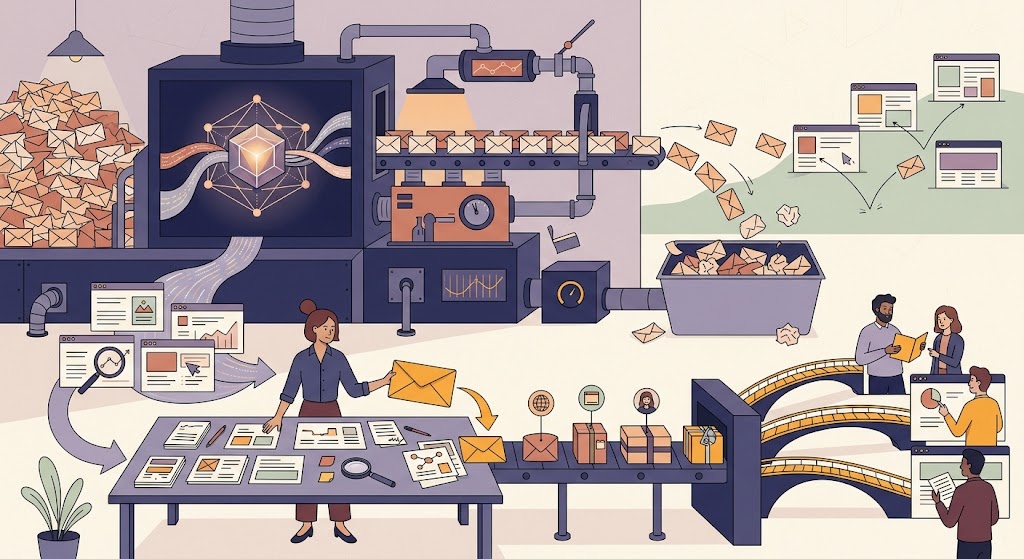
The sites winning in 2026 aren't the ones sending the most emails. They're the ones using AI to do the boring, high-volume grunt work (research, filtering, enrichment) so a real strategist can spend their time on the part machines still can't fake: relevance.
What Real Campaigns Actually Show
To be straight with you: the two client results below came from manual, relationship-driven link building, guest posting, broken link building, and the skyscraper technique, not from automated prospecting software. We're including them because they prove the underlying principle this article is built on (relevance beats volume, whether or not automation is involved), not because AI drove these specific numbers.
One SaaS client started at a Domain Rating of 11 with just 10 ranking keywords. Over nine months, by targeting niche-relevant sites instead of chasing the biggest names available, they reached a Domain Rating of 61, ranked for 208 keywords, and grew from roughly 1,000 to around 19,000 monthly organic visitors. (Full breakdown in our Social Media Ads Tool case study.)
Another client, in communication SaaS, started with a thin, general backlink profile. Once we shifted the strategy toward relevant, niche-specific placements and branded keyword targeting, traffic increased 199% and keyword rankings nearly doubled within eight months. (See our Communication SaaS case study)
The lesson those campaigns actually teach: relevance-first targeting works whether a human is doing the prospecting by hand or AI is helping filter the list faster. Automation doesn't replace that principle. It just removes some of the friction in applying it at scale, if it's used to speed up research rather than replace judgment.
The Tools That Actually Matter (Named, Not Vague)
Most guides in this space either name a dozen tools and let you sort it out, or push one platform because they built it. Here's a straightforward breakdown of the categories that actually matter and where each one earns its place.
Backlink gap analysis:
This is where you find out which sites link to your competitors but not you. Ahrefs' Site Explorer and Semrush's Link Intersect feature both do this well, and it's genuinely one of the highest-leverage steps in the whole process, because every domain on that list is already proven to link to sites like yours.
Prospect filtering:
Raw backlink exports are messy, full of expired domains, link farms, and sites with more spam signals than real traffic. An LLM (Claude, ChatGPT, or similar) can run a filtering pass on scraped domain data far faster than a human scanning spreadsheets, flagging thin content, mismatched niches, and obvious junk before anyone spends time on it.
Contact verification:
A great prospect list is worthless if half the emails bounce, and bounces quietly damage your domain's sender reputation over time. Hunter is a common, straightforward choice here for finding and verifying contacts at the domain level.
Outreach sequencing and personalization:
This is the layer where most of the vendor-published "best of" lists live, tools like Pitchbox, Respona, and BuzzStream all manage sequencing and follow-ups, with varying degrees of AI-assisted personalization. We'd flag one thing plainly: the personalization these tools generate is a starting draft, not a finished pitch. The tools that claim to fully automate this step end-to-end are usually the ones producing the generic-sounding emails editors delete on sight.
What doesn't get automated, in our experience:
Reading the actual target article and writing the one or two sentences that prove you read it. That's still the difference between a placement and a deleted email, no matter what a platform's marketing page claims.
Neither option is inherently better. A well-run DIY stack with real editorial discipline can outperform a lazy agency, and a good agency can outperform a DIY stack nobody has time to actually run properly. The failure mode on both sides is the same: treating the tooling as a substitute for judgment instead of a way to get judgment applied faster.
A Skeptic's Guide to Automation Vendor Claims
Since a lot of what ranks for "AI link building tools" is written by the vendors themselves, it's worth knowing which claims deserve a second look before you buy in.
None of this means automation tools are bad. It means the burden of proof should sit with the vendor, not with your assumption that a bold claim on a pricing page is accurate.
Step-by-Step: Running a Competitor Gap Campaign
Step 1: Find the right gaps.
Pull competitor backlink profiles and look for domains linking to them but not you. Skip the instinct to chase the biggest names in the space, enterprise giants have unlimited inbound interest and won't reply. Mid-weight niche competitors close to your own size are where the realistic opportunities sit.
Step 2: Score prospects automatically, then review by hand.
Run the raw list through AI-assisted filtering to flag low-relevance sites and spam signals before a human looks at it. This catches a lot of what used to take hours of manual spot-checking.
Step 3: Write a pitch that isn't "Dear Webmaster."
The prospect list can be perfect and the pitch will still flop if it opens with a template that could've been sent to anyone. A contextual angle, a content refresh suggestion, an asset upgrade, something that shows you actually read the article, outperforms list size every time.
What to Avoid: Common Pitfalls in Automated Outreach
Mistake #1: Trusting marketplace credits without checking relevance.
A lot of automated platforms sell "link opportunities" that are really just inventory. A placement on a site with zero topical overlap does very little for rankings and can look unnatural to search engines.
Mistake #2: Skipping email verification.
Hard bounces damage your domain's sender reputation over time, a cost that compounds quietly until it's suddenly very visible.
Mistake #3: Generic templates that ignore the target article.
If your pitch could be copy-pasted into a hundred inboxes without changing a word, it gets treated like the hundred other pitches that publisher already ignored today.
Frequently Asked Questions
Can you fully automate link building outreach without getting penalized?
You can automate the operational workflow, backlink extraction, data filtering, and email verification, without risking a penalty. Fully automating the pitching and personalization stage with generic templates or unverified lists will damage your sender reputation and can look unnatural to search engines. A hybrid approach, AI for data processing, human oversight for messaging, is the safer path to scaling.
How do you use AI for link building prospecting?
AI processes raw SEO exports from tools like Ahrefs or Semrush. Instead of manually auditing thousands of referring domains, an LLM can analyze site content, check topical relevance, filter out link farms or spam networks, and surface likely editor contacts in minutes.
What is a competitor backlink gap analysis?
A backlink gap analysis compares your backlink profile against direct competitors to find domains linking to two or more of them but not to you. Those domains are high-intent prospects that already publish content in your industry.
Why do automated link-building campaigns fail?
Most fail because they prioritize volume over relevance. Blasting generic templates to unverified addresses triggers spam filters, damages domain reputation, and produces low conversion rates. Successful automation focuses on data hygiene and specific, contextual pitch angles, not send volume.
Should I build my own automation stack or hire an agency?
It depends on whether you have the in-house time to manage prospecting, filtering, and outreach oversight consistently. A disciplined DIY stack (Ahrefs or Semrush for gap analysis, an LLM for filtering, Hunter for verification) can work well for teams with the bandwidth. Teams without that bandwidth typically get better results from a managed service, provided the agency is applying real editorial judgment rather than running the same generic automation the DIY tools offer.
Are vendor claims about AI automation in link building reliable?
Treat specific, sourced numbers (sample size, date range, methodology) as more credible than round, unsourced claims like "98% accuracy" or "guaranteed placements." Since most published rankings of AI link building tools are written by the vendors themselves, claims worth trusting are the ones vendors are willing to show their work on.
Conclusion
Automation is an amplifier, not a strategy. If the underlying targeting is weak, automation just helps you fail faster and at greater volume. If it's rooted in real relevance and genuine competitor gaps, automation is what lets you execute that strategy at a scale no manual process could match on its own.
If you're not sure where your current link building pipeline falls on that spectrum, that's usually worth an outside look. LinkyJuice works through exactly this kind of audit with clients, which is the foundation of our SaaS link building services.
About the Author
Davit Nazaretyan writes about link building, backlink audits, and SEO automation at LinkyJuice. His work focuses on separating what actually moves rankings from what just looks like it does: from cleaning up toxic backlink profiles to building outreach systems that hold up against algorithm updates. Connect on LinkedIn.