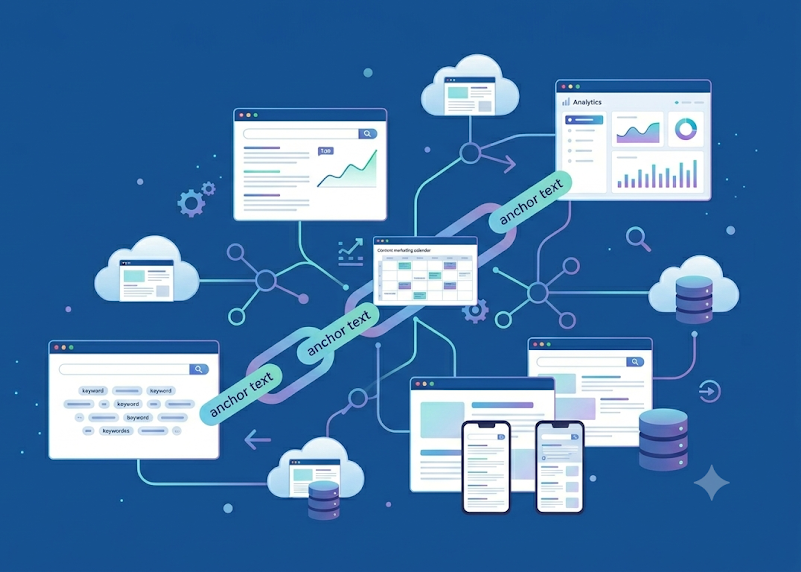
Anchor text looks like a small, unimportant part of a page. It isn't. These clickable words tell users and search engines what the linked page is about, and how two pages connect.
Search engines read anchor text as part of how they rank a page. Get the ratio wrong, and the same signal that helps your rankings can trigger a penalty instead. This guide covers what anchor text is, the ratios that work in 2026, and how to use it without overdoing it.
What we've learned here comes from managing backlink profiles across SaaS, martech, and PPC clients, not just theory. See our case studies.
What Is Anchor Text?
Anchor text is the visible, clickable text in a hyperlink.
Example: In "learn how to rank higher on Google," the words "rank higher" are the anchor.
In HTML:
<a href="https://example.com">rank higher</a>
Two separate jobs happen here:
- The destination tells a browser where to go.
- The anchor text tells a reader, and a search engine, what to expect there.
The clearer and more descriptive the anchor, the better it does that job.
The Types of Anchor Text (with Examples)
Say you're on a music blog linking songs to YouTube videos. One entry is "All My Love" by Led Zeppelin.
A strong profile uses a mix of all seven. Leaning on just one or two is what triggers the mistakes covered further down.
The Ideal Anchor Text Ratio
Why the difference? Google assumes you're describing your own site honestly when you link internally. It's more suspicious of exact-match anchors from other people's sites, since that pattern is easier to manufacture.
Sitting well outside these ranges, especially exact match above 10%, is worth fixing before it becomes a ranking problem. Here's how.
How to Audit and Fix an Over-Optimized Anchor Profile
Drawn from how agencies actually run this audit:
Pull and categorize your full backlink profile.
Export every external link pointing at the page from Ahrefs or Semrush, then sort each anchor into one of the seven types above. Now you have your actual ratio, not a guess.
Benchmark against competitors, not just the general range.
Pull the same data for pages currently outranking you. Use the median, not the average, since one outlier with thousands of forum links can skew a mean but not a median. That median reflects what's actually working in your SERP.
If exact match is high, stop building more of it.
Above 10% is a warning sign. Halt new exact-match link acquisition first, don't touch existing links yet, disavowing isn't the first move.
Build offset links to rebalance.
Add branded, generic, and naked URL anchors to shift the profile back toward natural. Calculate the gap between your current numbers and your target ratio to know roughly how many of each type to build, and over what timeframe. A common pace: a handful of offsetting links per week for 6 to 8 weeks, then re-check.
This is slow on purpose. A ratio that shifts overnight looks as unnatural as the problem it's fixing.
How Anchor Text Works in SEO
Anchors help users navigate, but they do more:
- Search engines crawl internal and external links to understand how pages connect.
- When multiple pages link to the same destination with similar phrasing, search engines associate that destination with a topic.
- The words around a link matter too, the surrounding sentence, the linking page's topic, not just the anchor itself.
That's why an anchor fitting naturally into a sentence carries more weight than one that reads like it was inserted for SEO. Anchor text should also accurately describe its destination. A link that says "pricing" but leads to a blog post damages trust as much as it damages user experience.
Internal Linking and Anchor Text Strategy
Internal linking is one of the most controllable SEO tools you have, and anchor text is what makes it effective.
A well-organized internal linking system, related pages connected through descriptive anchors, builds topical relevance across your site. The topic cluster model works well: a pillar page supported by related articles, linked with anchor text that signals how each piece fits the bigger picture.
Does Anchor Text Matter for AI Search?
This is genuinely murky territory, and it's worth being direct about what's actually known versus inferred. Ahrefs' analysis of 75,000 brands found branded anchor text correlates at 0.527 with AI Overview visibility; notably higher than raw backlink count (0.218). But branded anchor text is simultaneously a backlink and a brand signal, so this doesn't prove anchor text itself is the mechanism; it's better read as evidence that brand/entity signals matter broadly, not that AI systems specifically weigh anchor wording the way Google's classic ranking algorithm does.
Anchor text still matters for traditional ranking signals. It's just not the lever it once was for showing up inside an AI-generated answer.
This connects to a shift we've covered elsewhere: AI systems increasingly evaluate content based on E-E-A-T and information gain rather than isolated on-page signals, and structuring content for passage-level extraction matters more than any single anchor choice.
What Anchor Text Can (and Can't) Tell You
Anchor text can help communicate what a destination is about, how two pages relate, and what a reader should expect after clicking.
Anchor text cannot tell you that Google will rank the page, that a backlink is authoritative, that the link passes meaningful ranking value, that a specific exact-match percentage is optimal, or that an AI system will cite the destination.
Common Mistakes to Avoid
How to Improve Your Anchor Texts
Frequently Asked Questions
What is the ideal anchor text ratio?
External backlinks: roughly 30 to 50% branded, 15 to 25% partial match, 10 to 20% generic, 5 to 15% naked URL, 1 to 5% exact match. Internal links: 50 to 60% partial match, 35 to 45% branded/generic/naked, up to 10% exact match.
Do exact match anchors still work in 2026?
Yes, in small amounts, though they aren't inherently more valuable than other descriptive anchors. Exact-match anchors can provide clear topical context, but repeatedly forcing them creates an unnatural pattern that's easy for Google's systems to detect. Descriptive, natural anchors that happen to include relevant language usually accomplish the same thing with less risk.
Does anchor text matter for AI search like ChatGPT and Perplexity?
It's genuinely unclear how much anchor text itself matters versus the broader context around it. Ahrefs' research found branded anchor text correlates with AI Overview visibility, but that's likely picking up a broader brand-recognition signal rather than proof that AI systems specifically weigh anchor wording. Focus on making the anchor and its surrounding content clear and relevant rather than trying to reverse-engineer what an AI system might prefer.
How many internal links should a page have?
There's no fixed formula for internal link count. Google says there's no magical ideal number of links. Add as many as genuinely help users navigate and understand how pages relate, and avoid adding links purely to hit a quota.
What's the difference between internal and external anchor text rules?
Internal links allow more exact-match anchors, since you control the context. External backlinks need a more conservative mix, an unnatural concentration of exact-match anchors from other sites reads as manipulation.
Can anchor text over-optimization hurt my rankings?
Yes. Too many exact-match anchors, especially built quickly, is one of the clearest manipulation patterns search engines look for. Google may discount those links entirely.
What anchor text should I avoid?
Generic phrases like "click here" where context matters, misleading anchors that don't match their destination, and repeating the same anchor across many pages.
So What Actually Matters?
Anchor text is small, but it's doing real work: helping content get discovered, labeled, and organized, and helping search engines and AI systems understand the context around your brand.
Keep anchors natural and varied, benchmarked against what's actually working in your SERP rather than a fixed percentage. Make sure every one is genuinely useful to the reader clicking it. Done well, this improves user experience, site visibility, and search performance, without aggressive optimization tactics.
For a deeper look at how AI search evaluates content quality beyond individual signals like anchor text, see our guide on SEO in 2026.
If you need help putting this into practice, LinkyJuice is here for you. We make internal linking and SEO structure easier to manage, so your content performs better without the guesswork. Book a call and we'll take a look at your current anchor profile together.
About the Author
Davit Nazaretyan writes about link building, backlink audits, and SEO automation at LinkyJuice. His work focuses on separating what actually moves rankings from what just looks like it does: from cleaning up toxic backlink profiles to building outreach systems that hold up against algorithm updates. Connect on LinkedIn.