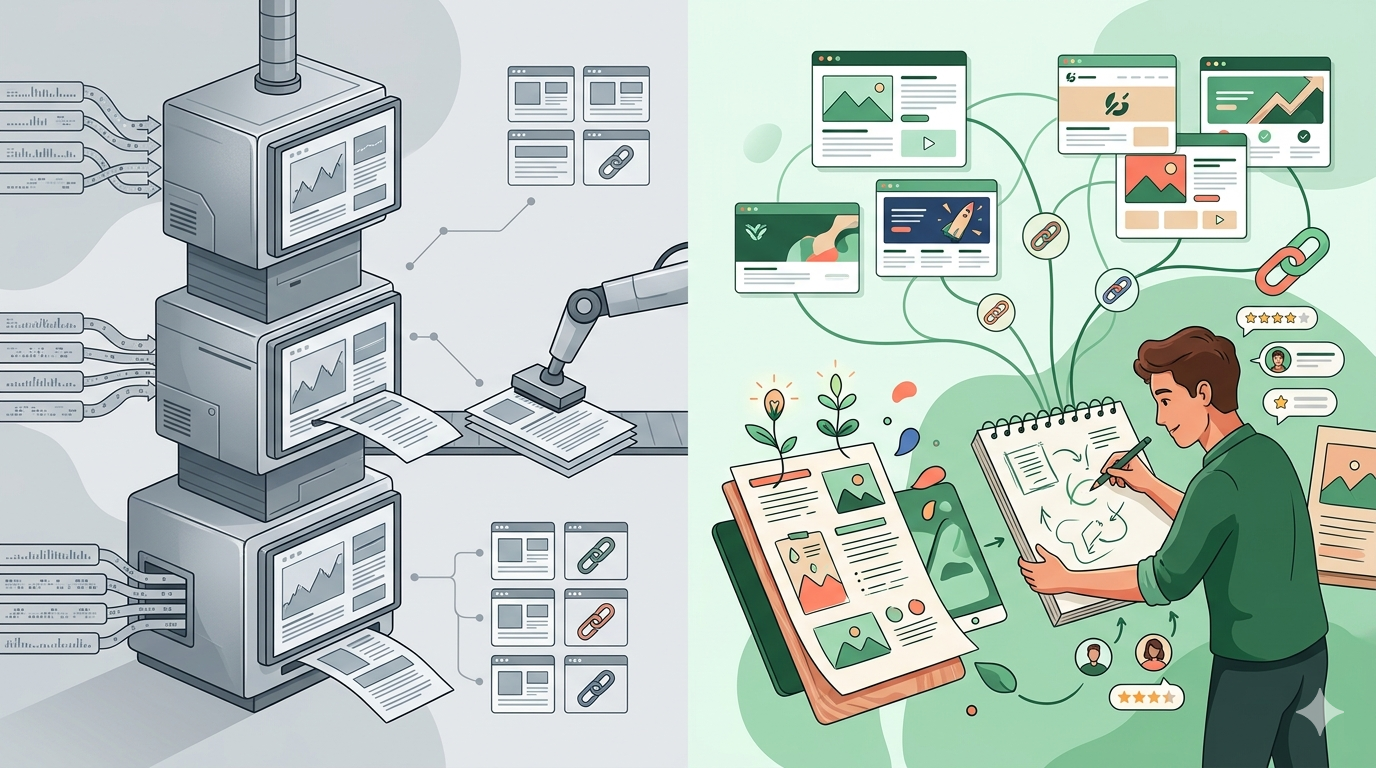
Backlinks do not evaluate how content was produced. They respond to whether content is credible, original, and useful enough to cite. In 2026, that citation threshold, not authorship method, is what determines backlink growth.
LinkyJuice has audited backlink profiles across SaaS, affiliate, and content publishing sites that scaled AI content heavily in 2024 and 2025. This guide is based on the citation patterns observed in that work.
Many SaaS and affiliate sites that scaled AI content in 2024 and 2025 still rank today. Their backlink growth flattened during the same period. Editors stopped referencing these pages once competing pages became structurally identical. Visibility remained. Citation did not. For a closer look at where these link acquisition patterns are headed, see our guide on the Future of Link Building.
Backlinks Respond to Citation Value, Not Authorship Method
Human content is often assumed to win by default because it aligns more naturally with E-E-A-T signals: expertise, authority, and trust. Human-authored pages also tend to carry stronger author profiles, more consistent brand voice, and clearer editorial oversight.
Finance blogs illustrate this pattern directly. Journalists and niche publications tend to link to analyst-written explainers over AI-written competitors when citing complex topics, even when both rank on the same page.
The underlying mechanism is not authorship identity. It is what that identity signals about usefulness. Search engines and editors evaluate usefulness through clarity, originality, engagement, and whether a page fills a genuine gap in existing coverage.
In keyword research guides and other SEO tools content, pages built around original datasets or proprietary surveys outperform generic AI summaries in backlink acquisition, even when both rank on page one. Ranking performance and backlink acquisition are separate outcomes. A page can maintain SERP visibility through multiple algorithm updates and still fail to accumulate editorial backlinks if it does not function as a reference point.
The Three Content Categories That Actually Matter
Treating "AI content" and "human content" as two categories oversimplifies how content actually performs. A more accurate framework separates content into three categories: pure AI content published with no editorial oversight, AI-assisted content refined through human editorial review, and fully human-written content.
These three categories perform differently across ranking position, backlink acquisition, E-E-A-T strength, and citation rate inside AI-generated answers. Pure AI content underperforms across all four dimensions when published without editorial reinforcement. AI-assisted content with real editorial oversight closes most of that gap, in some analyses performing within single digits of fully human-written content on ranking position specifically, while still lagging on backlink acquisition and E-E-A-T strength. Fully human-written content remains the highest-performing category across all four dimensions, at a production cost that does not scale as easily.
This shift is already underway at scale. According to Ahrefs, 74% of new web content now includes AI involvement in some form. Only 19% of SEO professionals report that AI actually improves content quality. The gap between those two numbers is the gap this framework explains: AI adoption has scaled far faster than AI content quality has improved, and backlink data reflects that gap directly.
AI Content: Strong Visibility, Weak Differentiation at Scale
AI content is highly effective at improving SEO performance in 2026. AI tools generate keyword-rich drafts, structured outlines, meta descriptions, and search-intent-aligned pages at scale, covering keyword gaps faster than most human teams can match.
Large programmatic SEO sites and affiliate content networks demonstrate this pattern clearly: AI content floods topic clusters, ranks quickly, and captures long-tail search results. Backlink accumulation does not scale at the same rate. Backlink tools frequently show a flat link curve on these domains: many pages rank, but few earn editorial backlinks over time. Technical optimization improves how content performs in search. It does not improve how content gets cited.
This creates a visibility ceiling. Without backlinks, ranking performance alone has a limit. AI-heavy content also shows more volatility during major algorithm updates when it lacks depth, not because AI authorship is penalized directly, but because quality and trust signals weaken as similar content proliferates across the web. Many AI-first affiliate sites show the same pattern: an initial growth spike, followed by stagnation once search results fill with structurally similar pages.
This pattern is not unique to content authorship. It shows up in link building generally whenever volume substitutes for differentiation. In one case, a content site added 55 guest post and niche-edit links in month one and gained an 18% traffic increase. A similar batch of 48 additional links in month two, at the same quality level, produced only a 2.1% traffic increase, even though Domain Rating kept climbing throughout. Volume without added differentiation produces diminishing returns whether the volume comes from links or from content.
Editorial backlinks follow perceived credibility, not visibility alone. A page that lacks strong authority signals typically does not get referenced, even while it ranks.
Human Content: Slower to Produce, Naturally More Citable
Human-written content aligns more directly with how search systems evaluate trust. Health and finance content illustrate the exception to this pattern: expert-led human content does not always outperform strong AI competitors in backlink volume, even when both rank similarly, since backlink acquisition depends on more than authorship alone.
Strong human content typically carries clearer E-E-A-T signals: stronger author profiles, more consistent brand voice, and better-established expertise. It also tends to perform better on engagement metrics, since readability and narrative structure in human writing are usually more intentional. Engagement reinforces usefulness signals inside search systems, which makes it a meaningful factor rather than a vanity metric.
First-person case studies in SaaS content, such as a detailed account of reducing churn by a specific percentage, consistently earn more backlinks than generic AI-written explainers on the same topic, even when the AI version ranks higher. Content built around expert commentary, original research, and problem-solving case studies earns editorial backlinks more reliably than AI-generated content, because this content establishes a perspective rather than only explaining a concept.
E-E-A-T Is a Citation Filter, Not Just a Ranking Signal
E-E-A-T (Experience, Expertise, Authoritativeness, and Trustworthiness) functions as a citation filter in addition to its role as a ranking factor. Search systems evaluate whether content originates from genuine expertise or generic assembly, and that evaluation increasingly determines backlink acquisition directly.
Wikipedia-style pages and expert-written medical content attract high backlink volume not because they are optimized for search, but because they function as trusted reference points. Two pages covering identical information can produce different SEO outcomes when one carries stronger credibility signals and the other does not. To understand more about online authority, see our guide on the hidden role of brand mentions. Pages that are technically identical in speed, mobile usability, and layout stability can still perform differently in backlink acquisition when one page carries stronger trust signals than the other.
Will Google Penalize AI Content?
Google does not penalize content specifically for being AI-generated. Google's ranking systems evaluate content quality, helpfulness, and originality, regardless of production method.
The practical risk is indirect. AI content published without editorial oversight tends to produce the same quality patterns across many pages: similar structure, similar phrasing, and limited original insight. Those patterns reduce perceived credibility and trust signals, which affects both ranking stability during algorithm updates and backlink acquisition. The risk comes from the quality pattern AI content tends to produce at scale, not from AI authorship itself.
Does AI-Written Content Get Cited by AI Search the Same Way?
AI-generated answer engines, including AI Overviews and conversational AI tools, evaluate citation-worthiness using signals similar to those used for editorial backlinks: credibility, originality, and topical authority.
Content produced with heavy AI assistance and minimal editorial oversight faces the same differentiation problem in AI search that it faces in traditional backlink acquisition. If many competing pages carry similar structure and similar information, an AI system has little basis to select one over another as its cited source. Original data, expert commentary, and case studies that establish a distinct perspective are more likely to be cited by AI search systems, for the same underlying reason they earn more backlinks: they give a system something specific to attribute to a specific source. For a deeper breakdown of how link acquisition itself is changing under AI-driven search, see our guide on Link Building in the Age of AI.
Hybrid Content: Where AI and Human Converge
Most high-performing content systems in 2026 do not choose between AI and human production. They combine both in a structured workflow.
AI handles the first layer: structuring outlines, mapping search intent, generating keyword-rich first drafts, and scaling production across large topic clusters. Human editors handle the second layer: refining tone, improving readability, strengthening brand voice, and verifying accuracy against real audience expectations. Subject-matter experts are brought in at this stage to reinforce E-E-A-T signals with direct expertise. Meta descriptions and title tags are finalized for search intent and click behavior at this stage as well.
This hybrid structure directly addresses the failure modes of each individual approach. Pure AI content fails when it becomes too generic to differentiate. Fully human content fails to scale or align with structured SEO systems when a team lacks the resources to produce it at volume. In some analyses, AI-assisted content with real editorial oversight performs within single digits of fully human-written content on ranking position specifically, while also closing most of the backlink and E-E-A-T gap that pure AI content shows.
Companies using hybrid production systems generally see more stable growth than companies scaling content purely through AI, because hybrid content ranks quickly while embedding the authority signals that make it citable. Many hybrid systems operate as tiered production models: high-value pages receive full E-E-A-T reinforcement and expert review, while lower-tier pages focus primarily on search coverage and structure. This creates a clear separation between content built for ranking coverage and content built to earn citations and authority, which allows performance to compound beyond individual page rankings into sustained trust across a domain.
How AI, Human, and Hybrid Content Perform by Industry
SaaS blogs using AI-assisted workflows frequently scale informational content across entire keyword clusters. These pages rank well and can capture featured snippets, particularly when structured around AI-assisted keyword mapping. Backlink data shows a different pattern within the same sites: AI-heavy pages generate substantial search visibility but earn comparatively few backlinks.
Finance and health publishers using expert-led content attract more editorial backlinks within the same competitive landscape, driven by expert attribution, direct experience, and original research. Pages built around proprietary surveys, original datasets, or documented real-world experience outperform generic informational AI content in backlink acquisition, even when they rank in a lower position. This pattern is especially visible in B2B SaaS, where hybrid case studies frequently become the most-linked assets on an entire domain. Problem-solving content built on original data, rather than paraphrased summaries, is more likely to be referenced by blogs, newsletters, and journalists.
Why Traffic Alone Doesn't Measure Content Success
Traffic alone does not capture full content performance. A complete measurement approach tracks backlink acquisition rate, engagement depth, ranking stability across algorithm updates, and return on investment over time.
AI content can rank quickly and cover large topic areas. Hybrid and human-led content outperforms over longer time horizons on backlink acquisition, authority building, and ranking consistency. This gap widens specifically during algorithm updates, when AI-heavy pages tend to show more volatility due to weaker trust and E-E-A-T signals. The real performance gap is not visibility. It is durability.
Best Practices for Content Creation in 2026
Start with AI-generated drafts built from search intent, keyword gaps, and SERP analysis.
Treat these drafts as efficient starting points, not finished output. See our roundup of the Best AI Tools for this stage if you're choosing between platforms.
Run an SEO optimization pass focused on readability, clarity, and engagement.
Finalize meta descriptions, title tags, and structural elements during this stage.
Tailor content to a defined reader profile rather than a generic audience.
Bring in subject-matter experts to verify accuracy and reinforce E-E-A-T signals with direct insight.
Match tone to the expected authority voice of the specific niche.
Even highly optimized content underperforms when its tone does not match reader expectations for that topic.
What Earns More Backlinks in 2026?
The starting question for any piece of content should be whether it is worth citing. AI content earns backlinks when it becomes distinct enough to stand out from similar AI-generated pages. Human content earns backlinks when it is structured well enough to scale and stay discoverable. Hybrid content performs best because it can achieve both simultaneously.
Backlinks reward perceived usefulness, as judged by users, editors, and search systems, not the production method behind a page. That perception is driven primarily by originality, credibility, and clarity of thought.
Frequently Asked Questions
Does Google penalize AI-generated content?
No, not for being AI-generated specifically. Google evaluates quality, helpfulness, and originality regardless of production method. The indirect risk comes from the repetitive, low-differentiation patterns AI content tends to produce at scale without editorial oversight, which weakens trust signals and reduces backlink acquisition.
Can pure AI content still rank in 2026?
Yes, particularly for informational and long-tail queries where competition is lower. Pure AI content typically underperforms on backlink acquisition and shows more ranking volatility during algorithm updates compared to AI-assisted or human-written content.
How much editorial oversight does AI content need to compete with human content?
Enough to add original insight, verify accuracy, and reinforce E-E-A-T signals through direct expertise. AI-assisted content with substantial editorial oversight can perform close to human-written content on ranking position, though it typically still lags on backlink acquisition without added original research or expert commentary.
Does AI-written content get cited by AI search tools like ChatGPT and AI Overviews?
Less often than content with a distinct, original perspective. AI search systems favor content that offers specific, attributable information over generic summaries, the same differentiation problem that limits AI content's backlink acquisition applies to AI citation as well.
What's the fastest way to make AI-assisted content more citable?
Add original data, a documented case study, or expert commentary that a generic AI-generated draft would not otherwise contain. This gives editors and AI systems a specific, attributable reason to reference the content.
Final Thoughts
The debate over AI versus human content treats two production methods as competing systems. Backlink and citation data point to a single system instead, one built on citation-based visibility rather than authorship identity.
AI improves speed and structure. Human involvement improves authority and interpretation. Hybrid production combines both to produce content that is scalable and citable at the same time. Backlink growth in 2026 does not come from ranking quickly or from maximizing human-written volume. It comes from content that holds up technically, contextually, and credibly, regardless of how it was produced.
LinkyJuice helps brands build content systems that consistently earn links, not just rankings. Reach out to get started.