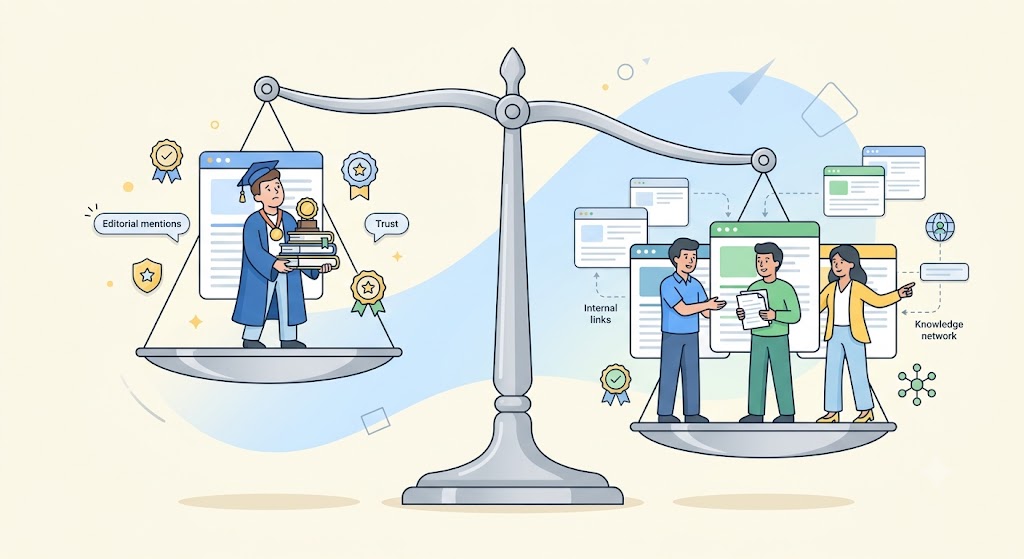
Two brands write about the same topic. Brand A publishes one genuinely excellent, deeply researched guide and calls it done. Brand B publishes a solid guide, then turns up on a podcast, in a Reddit thread, in an industry roundup, and in a handful of YouTube video descriptions. On a traditional results page, Brand A has a real shot. Rankings have always leaned hard on the strength of the individual page.
Increasingly, that's not the whole contest anymore.
62% of AI citations skip the top 10 entirely
Traditional search built its model around the document: crawl a page, evaluate it against a query, rank it against other pages. Backlinks pointed at that page mattered. Content quality on that page mattered. Domain authority accumulated over time. None of that has gone away, and it's still the foundation AI search is built on top of.
What's changed is what gets layered above it. AI systems increasingly synthesize answers from many sources at once, and a meaningful share of what they cite doesn't come from where you'd expect. Ahrefs analyzed 863,000 keywords and 4 million AI Overview URLs and found that only only 38% of pages cited in Google AI Overviews also ranked in the top 10 for the same query, down sharply from 76% just seven months earlier. The rest came from pages well outside the top 10, and roughly a third came from pages that never cracked the top 100 at all.
Sit with that for a second. A page can be nowhere near position one and still end up in the answer. That single stat is why "just rank higher" stopped being sufficient advice on its own.
What AI Notices Before Your Backlinks
Ahrefs' own researchers describe this as a move away from rewarding a single highest-ranking page, and toward rewarding whichever source helps answer a whole cluster of related questions with clarity and trust. That framing suggests a shift toward recognition, not just ranking position: search still opens the door, but recognition increasingly decides who gets cited once inside.
Here's a number that makes the point sharply. Ahrefs studied 75,000 brands to see what correlated most strongly with showing up in AI Overviews. Brand web mentions came out on top, correlating at 0.664. Backlinks, by comparison, sat at 0.218. Mentions outperformed links by roughly three to one, and brands in the top mention quartile pulled in up to 10 times more AI Overview appearances than the next tier down.
That's a big gap for one metric to open up. It's worth asking why.
Your Brand Probably Has Five Different Names Online
Traditional SEO starts with a keyword: what's someone typing, what page should answer it. AI-driven search adds another layer on top. It appears to lean on recognizable entities instead, meaning brands, topics, people, and concepts tied together by repeated relationships across the web, not just the wording on one page.
Here's a simple way to see the difference. Mention a brand once, in one place, and an AI model gets exactly one data point. Mention it consistently, described the same way, across independent and credible sources, and the model gets a pattern it can actually trust. One data point can be a fluke. A pattern is a lot harder to wave away.
That's also why sloppy inconsistency costs more than it looks like it should. A bio calling a company a link building agency here and a digital PR firm there. A directory listing running an outdated tagline. A podcast host who fumbles the name and nobody corrects it. A human reader shrugs it off. A model doesn't. It just takes longer to figure out what the brand actually is. Say it the same way everywhere, and every mention reinforces the last one instead of adding static.
Your Best Page Can't Vouch for Itself
Quality never stopped mattering. It just stopped being sufficient on its own. A flawless article sitting alone on a domain is still one data point, and AI systems increasingly look for corroboration before citing anything with real confidence.
A page can be genuinely useful, but AI systems seem to trust that usefulness more when something else backs it up: other sites referencing it, other sources describing the brand the same way, other mentions pointing back to the same information. Recognizing the pattern is only half the story, though. AI systems still have to decide which sources deserve that confidence in the first place, which is why How AI Search Chooses Which Sources to Trust matters just as much as the patterns themselves.
You Can Rank #1 and Still Get Ignored by AI
None of this replaces SEO fundamentals. It builds on them. Page relevance, rankings, backlinks, and authority signals are still the base layer. What's new sits on top: recognition, entity understanding, repeated patterns, and whether a brand is consistently associated with a topic across sources it doesn't control.
The old question was "how do I make this page rank." That question isn't going away, but it's no longer the whole job. Increasingly, what an AI system answers also seems to hinge on whether a brand is described accurately and repeatedly across the wider web, in other people's words, not just its own. Rankings aren't disappearing. Authority is just becoming as important alongside them, which is Why Authority Will Matter More Than Ranking is becoming a bigger conversation in modern SEO.
This is part of a broader change in how search visibility gets earned. For a deeper look at where SEO is heading, see our guide to the future of link building.
Frequently Asked Questions
Does AI search replace traditional SEO?
No. It adds a layer of recognition and pattern matching on top of the ranking factors that already existed, things like relevance, backlinks, and authority. The fundamentals still apply. They're just not the whole picture anymore.
Do backlinks still matter for AI search?
Yes, but their job has shifted. Backlinks are still a trust signal, but brand mentions and consistent entity recognition seem to correlate even more strongly with whether AI systems cite you.
How can brands improve visibility in AI search?
It seems to come down to how consistently and accurately a brand gets mentioned across credible, relevant sources, not just how one page ranks. Less a single tactic, more the overall pattern a brand leaves across the web.
What is entity SEO?
It's the practice of helping search and AI systems recognize a brand, person, or concept as one clear, consistent entity, rather than just optimizing individual pages around keywords.
How is AI search different from traditional Google rankings?
Traditional rankings evaluate one page against one query. AI search pulls from a much wider pool, including plenty of sources outside the top 10, and appears to favor whoever shows up as a consistent, trusted pattern across that pool.
Conclusion
AI visibility is built through consistent signals across the web: relevant mentions, editorial links, and authority that compounds over time. At LinkyJuice, we help brands earn those signals through link building and digital PR campaigns designed to build real recognition and lasting authority, not just chase rankings.
If you want to talk through what that looks like for your brand, book a call with us.
About the Author
Davit Nazaretyan writes about link building, backlink audits, and SEO automation at LinkyJuice. His work focuses on separating what actually moves rankings from what just looks like it does: from cleaning up toxic backlink profiles to building outreach systems that hold up against algorithm updates. Connect on LinkedIn.