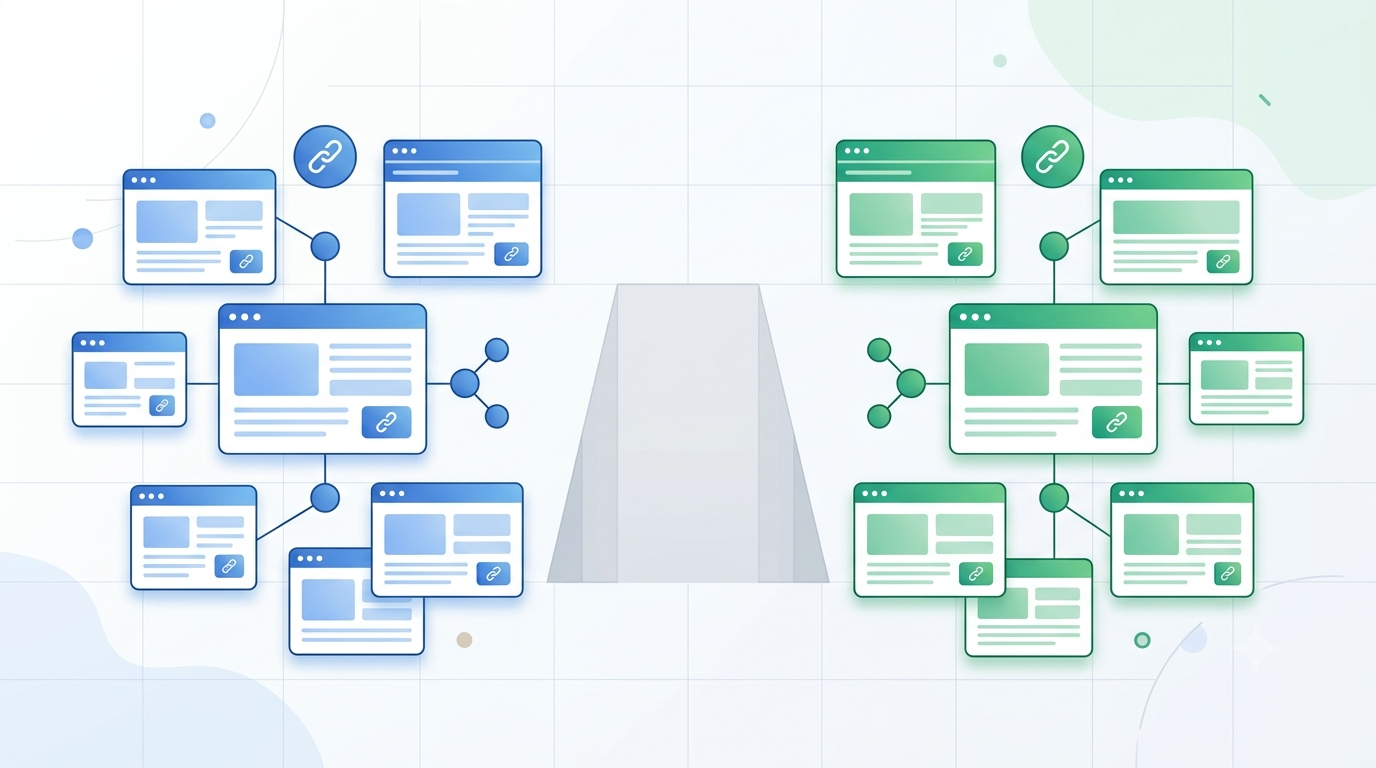
A backlink gap is the difference between the sites linking to your competitors and the sites linking to you. In 2026, that's only half the picture. Competitors are also getting mentioned and cited inside ChatGPT, Perplexity, and Google AI Overviews in ways standard backlink tools never show you. Here's how to close both gaps.
When most people hear "competitor backlink analysis," they picture massive spreadsheets or something close to SEO espionage. It's neither. A link gap strategy means understanding which backlinks your competitors have that you don't, and figuring out why those specific sites decided to link to them. It's a natural extension of understanding how backlinks earn authority in the first place, covered in How Do Backlinks Work in SEO?
There's no cloning involved. Just understanding what's working and building your own version of it, and increasingly, understanding a second gap most tools still don't measure at all.
What a Link Gap Actually Is
Think of it like industry invitations. You and your competitors all get mentioned in blogs, niche publications, and resource pages. A link gap is the difference in those invitations: where is your competition getting invited that you're not?
If the same sites keep linking to your competitors repeatedly, that tells you something concrete. Those sites already have a pattern of linking to brands in your niche, and you should be in that conversation too. In SEO terms, you're looking at your competitors' backlinks and asking which sources of authority they're actually drawing from.
Why Competitor Backlinks Matter More Than People Think
Search engines don't evaluate websites in isolation. They compare a site against everything else already ranking for the same terms. If competitors keep earning links from the same handful of sites, search engines start treating those sites as trust signals for the entire industry.
Ahrefs' own analysis found that the page ranking in position 1 on Google has roughly 3.8 times more backlinks than pages ranked 2 through 10, with the median page-one site carrying around 907 referring domains (via TheStacc's coverage of Ahrefs data), the same underlying pattern covered in Referring Domains vs. Backlinks. A separate 2026 WebFX study of 1,462 domains across 15 industries found that top-ranking sites gain an average of 48 new referring domains per month, ranging from about 15 in apparel to 101 in finance and insurance (via ReporterOutreach's coverage of the WebFX study). If most top-ranking sites in your space are being cited by the same 5-10 publications, those publications function as core trust signals for your entire niche, and a gap there is a visibility gap, not just a content gap.
The Gap Nobody's Tracking: AI Citations
Every traditional link gap tool answers one question: who links to my competitors that doesn't link to me. None of them answer a second, increasingly important question: who's getting mentioned or cited by AI systems that isn't me.
This isn't a minor addition to the concept. Ahrefs' own research, based on an analysis of 75,000 brands, found that how often a brand gets mentioned across the web correlates with AI Overview visibility roughly three times more strongly than raw backlink counts do (0.664 vs. 0.218) (Ahrefs, "An Analysis of AI Overview Brand Visibility Factors"). A competitor can be quietly building AI citation dominance in ways your backlink tool never surfaces, because a citation doesn't require a link at all. The same decay that affects backlinks over time affects AI citation eligibility too, covered in depth in Your Backlinks Are Dying, and AI Stops Citing You When They Do.
Checking this gap manually is straightforward, if unglamorous.
Take the target queries your competitors are known for, and run them through ChatGPT, Perplexity, and Google AI Mode directly, checking which brands actually get named in the response. Log which competitors show up, which sources the AI system cites, and whether you appear anywhere at all. Dedicated AI citation tracking tools are emerging, but a manual spot-check across your 10-15 highest-value queries takes under an hour and reveals the gap immediately.
The follow-up question matters more than the check itself.
Once you know a competitor is getting cited and you're not, ask why. Is it because they're mentioned in more industry publications overall? Do they have original data an AI system can cite with confidence? Is their content structured in a way that's easier to extract a clean answer from? The AI citation gap, like the backlink gap, is diagnostic. It tells you what's missing, not just that something is.
Not All Links Are Equal
Once you've mapped what your competitors have, the next step is filtering for what actually matters. What makes a backlink high-quality isn't domain rating alone, it's topical relevance, real traffic, trust, and where the link sits on the page.
A high-authority link from a random, unrelated page has less impact than a lower-authority link from a lesser-known site that's genuinely relevant to your industry, the core distinction covered in Domain Rating vs. Domain Authority.
A link from a DR 80 news site with a brief, unrelated mention won't move the needle much. A link from a DR 50 niche or technical site that discusses your product in depth carries more real weight. The same filtering applies when auditing a competitor's profile: most backlink portfolios contain a lot of low-quality links and only a handful of genuinely relevant ones. Sorting the two apart, before deciding what to chase, is what separates a useful gap analysis from a wasted spreadsheet.
How to Actually Run a Link Gap Analysis
Pull your competitors' backlinks using a gap tool.
Ahrefs' Link Intersect and Semrush's Backlink Gap both show domains linking to two or more competitors but not to you, the fastest way to surface a real, curated prospect list rather than a random one.
Group the results by link type.
Are they blog posts, comparison pages, listicles, or research citations? Different formats earn links for different reasons, blog posts earn links by teaching something, data pages earn links by giving people numbers to cite, and product comparison pages earn links because people want to weigh options.
Ask why each page earned its link, not just that it did.
You're reconstructing the actual reason a publisher decided this content deserved a reference.
Evaluate what's missing on your own site.
If most of your existing links point only to your homepage, that's the equivalent of everyone pointing at your front door. Search engines want to see the different rooms of your site, the specific pages that actually deserve depth and citation, not just the entrance.
Run the AI Citation Check Alongside the Backlink Check.
use the manual process described above, so the gap analysis covers both channels from the start rather than treating AI visibility as an afterthought.
Turning Gaps Into a Real Outreach Strategy
Once gaps are identified, the next step is outreach, and this is the stage where most campaigns either scale or stall.
Be selective before pitching.
Not every gap is equally valuable. If several competitors share a link from the same marketing blog, check why they got featured before reaching out. Was it a guest post, a product mention in a listicle, or a cited data source? That context determines the right pitch angle. A "top 10 tools" listicle calls for making the case your product belongs on the list. A data-heavy article calls for offering better, more current data or a genuinely different angle.
Organize prospects with the type of link attached, not just contact info, so outreach can be tailored rather than generic.
Personalization measurably changes response rates.
According to 2026 link-building data, well-executed, personalized outreach campaigns see response rates of roughly 8% to 15%, compared to 1% to 3% for generic, spray-and-pray campaigns (via TheStacc's coverage of 2026 link-building statistics). LinkedIn outreach paired with email can also outperform cold email alone; reported InMail reply rates for B2B outreach run in the 10% to 25% range.
Don't skip follow-ups.
Most link placements happen after the first email, not during it.
Why Copying Competitor Links Blindly Doesn't Work
It's tempting to see what worked for a competitor and replicate it exactly. That's a mistake, and a common one.
Blindly copying a competitor's full backlink profile risks chasing irrelevant directories, low-quality sites, or over-optimized anchor text patterns that were never good practice in the first place. Some competitor links may trace back to manipulative tactics, link farms or private blog networks, that carry real penalty risk if copied rather than earned. Others may have only been "safe" for that competitor because they were diluted across a much larger, higher-quality overall profile, something a smaller site copying just the risky pieces won't have the same protection from.
The fix is focusing on context, not content: understand why a link worked for a competitor, not just that it exists in their profile.
This Isn't a One-Time Process
A common misconception is that a link gap analysis gets run once and keeps producing value indefinitely. In reality, nothing about this is static. New referring domains appear, anchor text patterns shift, and a competitor landing one major feature can add dozens of high-authority links and shift their standing in a niche within a single news cycle.
Ongoing monitoring, reviewing competitor backlink activity and AI citation status on a recurring basis, is what keeps a gap analysis useful instead of turning into a one-time snapshot that goes stale within a quarter.
Frequently Asked Questions
What is a backlink gap analysis?
A backlink gap analysis compares your site's backlink profile against one or more competitors to find domains linking to them but not to you. It focuses on comparative performance rather than auditing your own site in isolation, prioritizing link quality and topical relevance over raw link count.
Is it safe to copy a competitor's backlinks?
Only selectively. Editorial links from legitimate, relevant publications are generally safe and effective to pursue. Replicating paid links, private blog network placements, or manipulative anchor text patterns carries real risk, since those tactics can trigger the same spam detection systems regardless of which site originally used them.
How is an AI citation gap different from a backlink gap?
A backlink gap identifies sites linking to competitors but not to you. An AI citation gap identifies queries where AI systems like ChatGPT, Perplexity, or Google AI Overviews mention or cite a competitor by name without citing you, which can happen even without any backlink involved, since AI citation increasingly correlates with brand mentions across the web rather than link counts alone.
How often should a link gap analysis be updated?
Competitor backlink profiles and AI citation patterns both change continuously, new referring domains appear, and a single major media feature can shift a competitor's standing quickly. Reviewing both gaps on a recurring basis, monthly or quarterly depending on how competitive the space is, keeps the analysis useful instead of going stale.
What tools are used for link gap analysis?
Ahrefs' Link Intersect and Semrush's Backlink Gap tool are the two most commonly used for finding domains linking to competitors but not to your site. AI citation gaps currently require a more manual process, running target queries through ChatGPT, Perplexity, and Google AI Mode directly and logging which brands get cited, since dedicated tracking tools for this are still emerging.
Does personalized outreach actually get better results than generic pitches?
Yes, substantially. 2026 link-building data shows personalized, well-targeted outreach campaigns achieving response rates of roughly 8% to 15%, compared to 1% to 3% for generic, unpersonalized campaigns. The gap comes down to relevance and timing, not volume of emails sent.
The Bottom Line
Closing a link gap was never about copying a competitor's homework. It's about understanding how authority gets built in your specific niche, backlinks and, increasingly, brand mentions and AI citations, and building your own version of that pattern deliberately.
The sites treating this as a one-time backlink audit are already missing half the picture. If you want help turning both kinds of gap analysis into actual links and citations that move the needle, that's exactly what we do at LinkyJuice.