Programmatic SEO sounds simple in theory: plug in structured data, generate hundreds of pages, rank everywhere. That's not how it actually works.
Some companies use programmatic SEO to dominate entire search categories. Others publish thousands of pages that never get indexed, never rank, and quietly get classified under one of Google's most actively enforced spam policies, a risk that's only grown as search shifts toward zero-click results and AI-generated answers. The difference between the two isn't scale. It's what the scale is built on.
What Programmatic SEO Actually Is
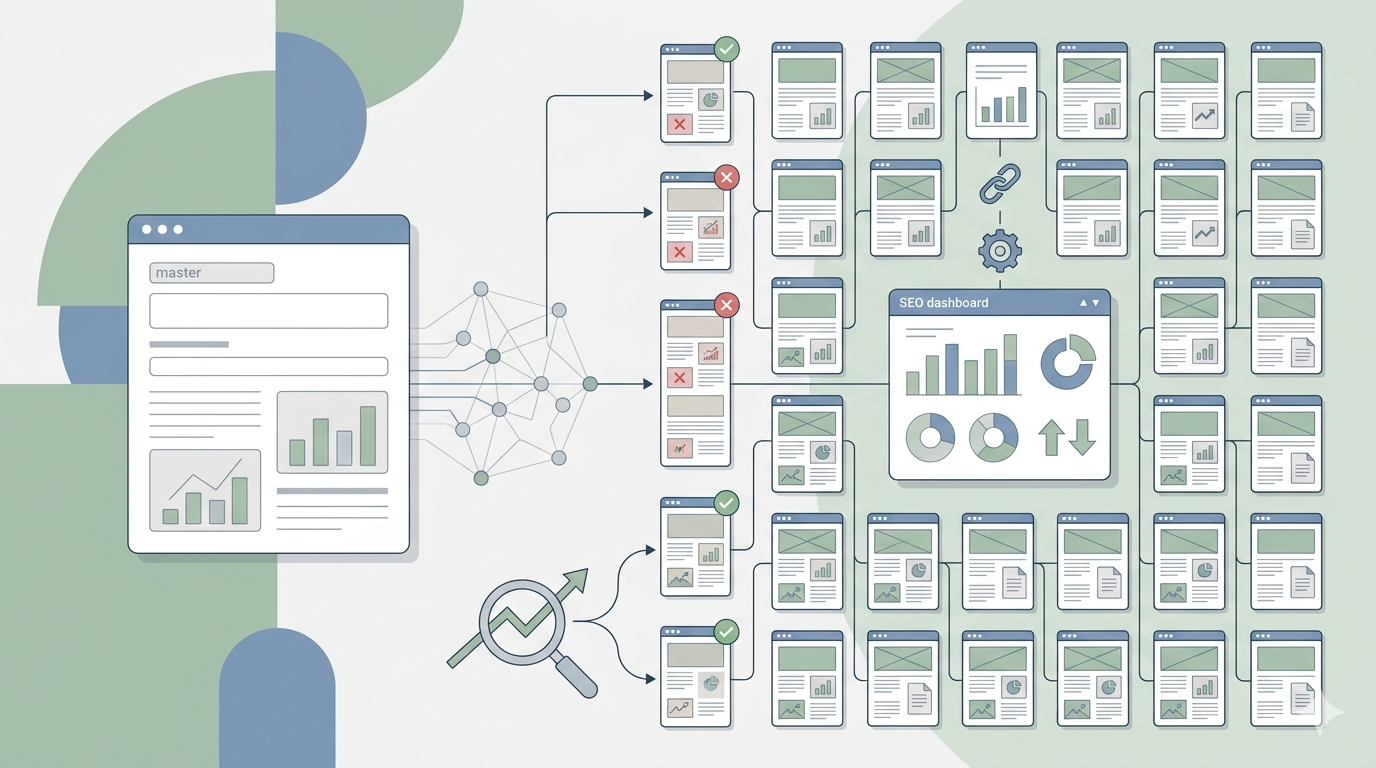
Programmatic SEO is a method for creating pages at scale using structured data instead of manual writing. A template pulls from a database and generates pages automatically, rather than a person writing each page individually.
Instead of one page about CRM tools for startups, a programmatic system can generate hundreds of pages, each tailored to a specific niche, feature, or use case. Data replaces manual writing at the page-creation stage, which is what makes the approach scale fast when it works.
Scaled Content Abuse: Google's Spam Policy for Programmatic Pages
Google has a specific, named spam policy called scaled content abuse, introduced in March 2024 and defined as generating many pages where the content is only slightly different, with the primary purpose of manipulating search rankings rather than helping users.
This isn't a theoretical risk anymore. Three separate Google spam updates ran in 2026, and programmatic content was a named focus area in more than one.
The March 24, 2026 spam update rolled out in under 20 hours, the fastest confirmed rollout in Google's dashboard history. Google's own guidance tied to this update named scaled content abuse specifically, alongside link schemes and expired domain abuse, as a primary target.
The August 18, 2026 spam update explicitly listed programmatic pages as one of the content categories site owners were advised to audit separately, distinct from editorial content, service pages, and user-generated sections, when checking for ranking losses.
The practical takeaway: programmatic pages that don't provide unique value per page are no longer just a vague quality problem. They fall under a specific, actively enforced Google policy, and being grouped incorrectly with a site's editorial content during an audit can hide exactly which pages are actually at risk.
Why This Works for Some Brands (And Not Others)
Looking at how successful companies actually operate makes the distinction clearer.
Zillow built massive page systems for real estate listings across cities, neighborhoods, and micro-locations. It scaled successfully because every page was rooted in real-world data people are genuinely interested in, pricing, availability, location-specific trends. These aren't SEO pages built to rank. They're useful pages that happen to rank.
Zapier created thousands of integration pages like "Connect X to Y." At first glance, that looks templated and repetitive. But each page solves a specific job to be done. Someone searching for how to connect two tools gets exactly what they need.
Canva scales template pages like "Instagram story templates" or "resume templates." This works not because of scale alone but because each page delivers instant usability. People don't just read those pages, they use them.
G2 built its entire model on structured software comparison pages, fed by proprietary review data rather than generic descriptions. The unique dataset is what gives each page real weight, the same kind of trust signal we cover in How AI Search Chooses Which Sources to Trust.
The pattern across every successful example: none of them rely on templates alone. Each one is built on real, often exclusive data that makes individual pages meaningfully different from each other, not just differently worded.
Common Programmatic SEO Mistakes That Trigger Penalties
The most common mistake is treating scale as the trick itself. Teams build thousands of pages based on keyword variations rather than real user needs, and that's where scaled content abuse classification becomes a real risk rather than a theoretical one.
If every page is a variation of the same template with no real difference in value, Google's systems read it as thin content, and users feel it too. Everything looks and reads the same without solving anything new.
Intent mismatch is the second common failure. A site might build separate pages for "best CRM for startups," "best CRM for small teams," and "best CRM for entrepreneurs," but if all three lead to nearly identical content, the pages exist to target keyword variations rather than to solve genuinely different problems. Automation isn't the problem here. Building a system that isn't grounded in actual usefulness is.
How to Make Programmatic SEO Work For You
Start with real data, not scraped content or generic descriptions.
Pricing, comparisons, user-generated insights, or proprietary information all add genuine value. Without it, pages become interchangeable with every competitor's version of the same template.
Keep a human strategy guiding the system.
The best programmatic setups don't remove humans, they reposition them. Humans decide what gets built, how data gets structured, and how intent gets mapped. The system executes at scale; it doesn't replace the judgment behind it. That's the same line separating useful automation from filler, covered in AI vs. human content.
Match user intent precisely, not approximately.
A page should feel like exactly what someone was looking for, not something merely related to it.
Build in real variation.
Even automated pages shouldn't feel like copy-paste repetition. The strongest systems introduce genuine context and subtle differences that make each page individually useful rather than interchangeably templated.
Aim for a real uniqueness benchmark, not just a feeling.
A commonly used practitioner rule of thumb is roughly 60% genuinely unique content per page, meaning specific data, context, or analysis that couldn't be generated by swapping a single variable in a template. This isn't an official Google threshold, Google hasn't published an exact number, but it's a useful working target for auditing whether a page actually clears the bar or is closer to a thin variation.
Putting It to Practice
Before anything else, ask what problem can be solved repeatedly using data, not what keywords can be targeted at scale. This single shift in framing filters out most bad programmatic SEO ideas before they get built.
Once that's clear, build the data layer first. This is the foundation of everything else; if the underlying data is weak, the pages will be too, regardless of how polished the templates look.
Then comes the template layer, where the most common mistake is over-templating. A good template organizes information clearly but leaves room for real variation, guiding the page rather than constraining it into sameness.
After that, add an editorial layer, the human input that shapes how the data actually gets presented. This is often subtle, but it's what turns a generated page into something that reads as intentional rather than assembled.
Test before scaling. Launch a small batch, watch how it performs, where users drop off, and where rankings stick or fail, then refine the system before expanding to hundreds or thousands of pages.
How to Check If Your Programmatic Pages Are at Risk
A real audit, not a general sense of quality, is the only reliable way to know whether a programmatic section is at risk or already affected.
Group URLs by template and content type before analyzing anything.
Separate programmatic pages from editorial guides, service pages, and user-generated content. Comparing a whole site's performance in aggregate hides which specific section is actually underperforming.
Check Search Console at the query and page level, not just site-wide.
A sharp decline in a specific programmatic directory's clicks and impressions is a much clearer signal than an overall traffic dip, which could stem from an unrelated part of the site entirely.
Watch indexed page counts for that section specifically.
A sudden or steady decline in how many programmatic pages remain indexed is one of the clearest early warning signs that Google's systems are actively discounting or dropping pages from that template.
Keep a control group of pages that didn't move.
This prevents a handful of visible losses from being read as a sitewide problem when the actual issue is isolated to one template or data source.
Review what changed and when.
Log deployment times for any bulk redirects, sitewide title rewrites, or automated page launches. During an active spam update rollout, pausing large structural changes makes it possible to isolate what the update actually affected versus what a separate change caused.
When we've reviewed programmatic sections for clients, the pattern is consistent: sites that keep clean records of what template covers what URLs, and check that segment specifically rather than relying on overall dashboards, catch problems weeks before sites that only look at aggregate traffic.
How to Build Backlinks to Programmatic Pages
Programmatic pages don't naturally attract links unless they're supported properly.
What works is building internal authority first through strong hub pages that connect everything. A "CRM Tools Hub" page linking out to "CRM for startups," "CRM for agencies," and "CRM for enterprises" gives the system a natural center of gravity. Instead of building links to every individual programmatic page, links get built to the system itself, the hub pages, tools, or data sources behind it.
Pages earn external links more easily when they read as references rather than landing pages. Datasets, comparisons, rankings, and tools are the kind of content people actually want to cite. Link building for programmatic SEO is less about pushing authority into individual pages and more about making the underlying system worth referencing in the first place. For where link building itself is headed next, see our guide to the future of link building.
Frequently Asked Questions
What is scaled content abuse, and does it apply to programmatic SEO?
Scaled content abuse is a specific Google spam policy, introduced in March 2024, that targets pages generated at scale where the content is only slightly different and primarily exists to manipulate rankings rather than help users. It applies directly to programmatic SEO when pages are built from keyword variations without genuine unique value per page. Programmatic pages built on real, differentiated data are not automatically classified this way; the risk depends on the value each individual page provides, not the production method itself.
Did the 2026 Google spam updates specifically target programmatic pages?
Yes, in part. The March 24, 2026 spam update, which rolled out in under 20 hours, named scaled content abuse as a primary target alongside link schemes and expired domain abuse. The August 18, 2026 spam update explicitly listed programmatic pages as a content category site owners were advised to audit separately when checking for ranking losses.
How much of a programmatic page needs to be unique to avoid penalties?
Google has not published an official percentage. A commonly used practitioner benchmark is roughly 60% genuinely unique content per page, specific data, context, or analysis beyond a single swapped variable. This is a working guideline for self-auditing, not a confirmed Google threshold, and pages built on genuinely proprietary or location-specific data tend to clear it naturally.
How can I tell if my programmatic pages have been affected by a spam update?
Group URLs by template and check Search Console at the query and page level for that specific section, rather than relying on site-wide traffic. A sharp decline in indexed pages for a programmatic directory, alongside falling clicks and impressions for that section specifically, is a clearer signal than an aggregate traffic dip, which could be caused by an unrelated part of the site.
Is programmatic SEO inherently spam?
No. Companies like Zillow, Zapier, Canva, and G2 all run large-scale programmatic systems that rank well and provide genuine value, because each page is built on real, often proprietary data and solves a specific, distinct user need. The method itself isn't the risk; pages built primarily around keyword variations with no meaningful per-page differentiation are what fall under Google's scaled content abuse policy.
How do you get backlinks to programmatic pages?
Individual programmatic pages rarely earn links directly. The more effective approach builds authority into hub pages that organize and link out to the programmatic pages beneath them, then earns external links to the hub, tools, or underlying dataset rather than to each individual page. Content that reads as a genuine reference, a dataset, comparison, or tool, attracts citations more naturally than a landing page does.
Is Programmatic SEO Worth the Risk in 2026?
Programmatic SEO is a force multiplier, in either direction. Built on strong data, real user intent, and thoughtful structure, it becomes one of the most effective SEO strategies available, scaling relevance in a way manual content never could. Built on weak inputs, generic content, keyword-first thinking, no real differentiation, it scales that weakness just as fast, and now runs directly into a specific, actively enforced Google policy rather than a vague quality penalty.
The real question isn't whether to use programmatic SEO. It's whether the system is scaling usefulness or just scaling pages, and whether that answer would hold up to an actual audit, not just a general sense that the content looks fine.
If you're ready to turn programmatic SEO into a real growth system that holds up under Google's current scrutiny, get in touch with us at LinkyJuice, and we'll help you build it properly.