Backlinks are the word of mouth of SEO. Useful but wildly ineffective on its own.
Back in the day, all you had to do was put out good content, maybe have a few people link to you, and you would be the belle of the ball in your industry. That’s all it took.
Now it’s a different world. With AI in search, that’s like trying to get noticed in a stadium full of people. Yelling louder or having a few shoutouts won’t guarantee you’ll be heard.
Search isn’t a list of pages anymore. It’s a record of everything about a subject, and links are just one piece of that reputation system.
What Actually Changed
Search used to work like a ladder. You build links, you rank higher, you get traffic.
It was very straightforward and more importantly, predictable.
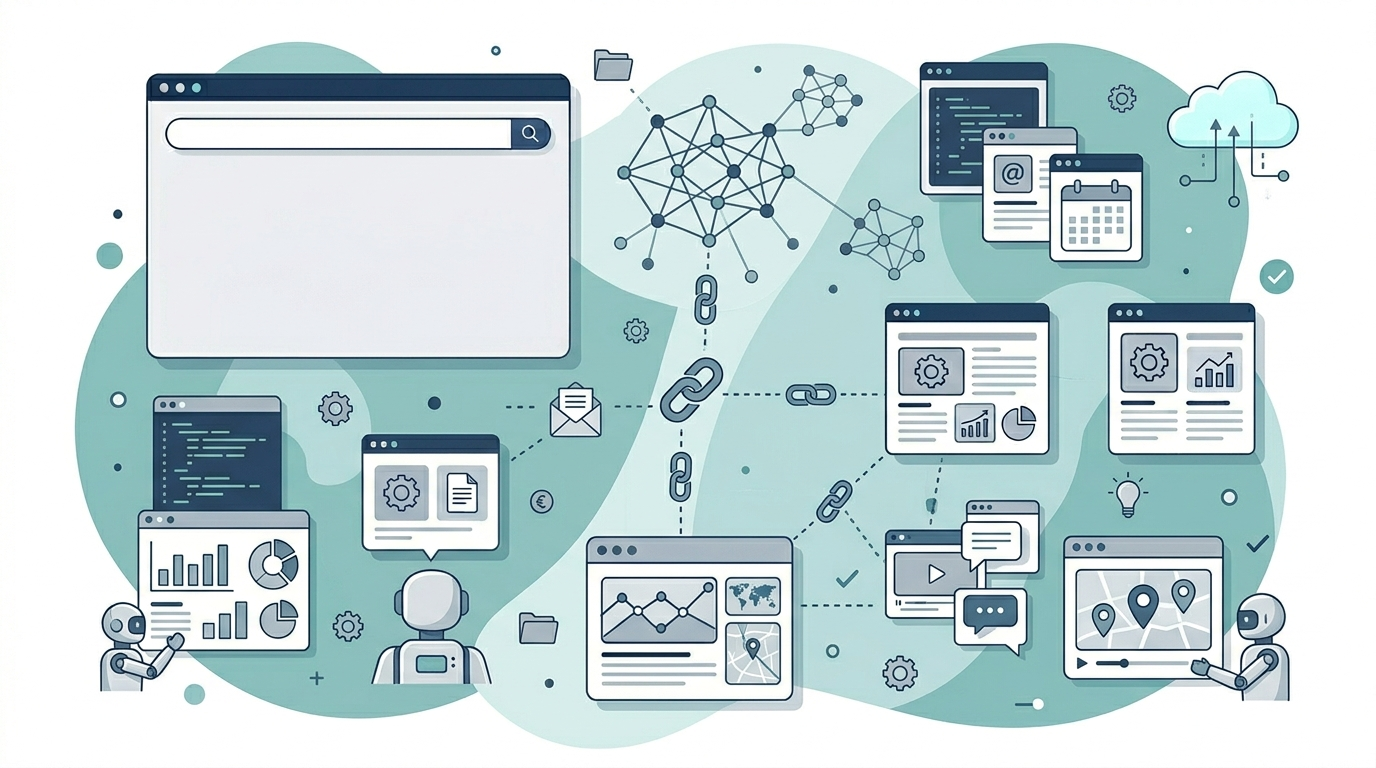
Now it works more like memory. Someone types a question, and AI pulls the answer from multiple sources: articles, reddit posts, reviews, directories, PR, and even brand mentions that don’t get links. Then it combines all of that into one answer, usually a summary.
That’s just how search works now.
A large Ahrefs study analyzing 1.9 million AI citations across 1 million answers found that:
- 76% of citations come from pages already in Google’s top 10
- Only 14% come from pages outside the top 100
This tells us that traditional SEO still matters. It shapes what AI can “see.” But it can’t control what gets used anymore. That comes from other brand signals.
A second Ahrefs study of 75,000+ brands found that AI visibility is driven mostly by how often your brand is mentioned online (this is the big one), how many people look it up, and how often it’s referenced on the internet.
Think of it like this: ranking gets you invited to the party. Whether people actually talk to you or remember you afterward (whether you show up in AI results) depends on how well-known and recognizable you are.
So ranking still matters. It’s just not the main focus.
If you want a deeper breakdown of where all of this is heading, check out our guide on SEO in 2026.
Authority Is The Real Game (not links)
A lot of SEO thinking is still stuck in the past.
We’ve already established that backlinks, while still relevant, aren’t the main thing AI looks to when pulling up answers. It’s more about presence.
If you look at how content actually spreads (from tools like BuzzSumo or PR distribution studies), there’s a clear pattern for how content gets “picked up.” It doesn’t blow up from one big source. It builds momentum over time.
It might start on niche blogs, then show up in listicles or comparison lists. People start talking about it on Reddit and communities. Then it ends up on “best of” lists. And finally, it shows up in AI-generated answers.
So for AI to trust your content enough to use it, your brand needs to show up consistently in a lot of spaces. It’s a long game and not about “getting good links”. At least, not anymore.
That’s why studies from Ahrefs and others keep finding the same thing: brand mentions and overall presence often matter more than just the number of backlinks.
Ultimately, AI systems want consistency. They’re watching for things like:
- Are you described the same way everywhere?
- Do different sources independently confirm your relevance?
- Is the overall sentiment about you strong?
- Are credible people or publications mentioning you?
- Are you showing up in trusted industry spaces?
A backlink is one person recommending you once.
Authority is when lots of different sources keep saying the same thing about you. And that’s what builds a reputation AI can trust (and recommend).
Putting It to the Test
We tracked around 120 SaaS domains over six months. In that time, we looked at two things side by side: how fast they were getting backlinks and how often they showed up in AI search results.
Some domains increased backlinks by 30–50% with almost no change in AI visibility. Others barely grew links but showed up far more often in AI results.
The difference was that the higher-visibility brands were consistently mentioned in podcasts, press articles, roundup pages, and reviews.
So backlinks help rankings, but brand mentions are what actually gets you into AI answers.
Reviews Are Doing Way More Work Than People Think
Reviews are the main ways AI figures out if a brand is trustworthy. It’s not even about star ratings (anymore). AI is looking for how many reviews there are, how recent they are, what people are actually saying, how companies respond, and how consistent the feedback is.
Airbnb is a really good example.
Even when smaller competitors rank well for specific travel searches, Airbnb still shows up a lot in AI-generated travel answers. Not just because it has reviews, but because it has: consistent positive feedback across the board, mentions on various platforms, a reputation of being the “obvious” option when travelling, and yes, a huge backlog of reviews.
AI doesn’t stop at review sites. It also takes into account what’s being said on platforms like reddit, forums, travel threads, and other discussions.
It’s basically looking at what people say about you everywhere.
How AI Chooses When To Use a Brand
Ok so, you built up an online presence, have a consistent streak of being mentioned. Now what? How do you actually know when AI is going to mention you?
Going through your brand’s footprint is how AI figures out who you are. To decide when it makes sense to use it, AI is basically asking: “what kind of questions is this the right answer for?”
Let’s walk through how this actually works.
Say someone searches for “tools for productivity.”
AI scans the internet: what tools exist, what are people saying about it, which ones are mentioned in different spaces. It builds a shortlist of names.
A tool like Notion will probably be on that list. It’s well-known, well-covered, and is a big name in productivity spaces.
But that’s just the first step.
Now AI is thinking: what exactly is the person trying to do? Because “productivity” is vague. It could mean taking notes, managing tasks, building a team workflow, or organizing personal life. So it starts narrowing down user intent.
If the follow-up feels like:
- “I just want a simple place to organize my thoughts”
- “What's a good all-in-one workspace for personal use?”
- “tools for flexible planning and note-taking”
Notion fits really well because it’s consistently associated with flexible, lightweight organization and personal productivity. So AI is like, “you might like this.”
But if the question leans more toward:
- “Structured project management for large teams”
- “Strict documentation systems for enterprises”
- “Formal workflows with permissions and hierarchy”
Notion won’t make the cut because that’s not what it’s known for.
when someone asks something online, AI basically goes through this process:
Step 1: It looks at what tools and brands are most commonly mentioned in that category.
Step 2: It interprets what kind of problem the user is trying to solve.
Step 3: It matches tools to that intent.
Step 4: It builds an answer based on that match.
So when AI is “choosing” which brands to show, it’s doing so based on user intent and like we said, reputation. Not just visibility.
How Visibility Actually Works
By now, we’ve established that having an online presence (a consistent one) matters a lot. Your brand needs to be seen as much as possible to start to be considered trustworthy.
But here’s what most people miss. Not all visibility is useful.
AI systems don’t just look for where a brand shows up. They look for whether that information can actually be used to answer a question.
Let’s say, you’re looking for a plumbing service and keep seeing the name “Diego’s Plumbing” everywhere. It pops up in directories, blog mentions, maybe a few local articles. That means they’re ranking, great. Here’s the problem, though: one place says they do emergency repairs, another mentions bathroom remodels, and another just lists them as “general plumbing.” There’s no clear pattern tying it all together. What do they actually do?
Compare that to a competitor company. Everywhere you look, you get the same story: 24/7 emergency plumbing, fast response times, specializes in burst pipes and urgent repairs. Same level of visibility, but way more “useful.”
If you need urgent plumbing, one of those names is easier to find, isn’t it? That’s how AI search works. If your name shows up everywhere but says something slightly different every time, the system won’t be able to use it in a clear answer.
So it gets skipped.
But if your presence consistently reinforces the same idea (same category and positioning), it becomes easy to understand and include.
Real-world examples
Zapier consistently shows up in “best automation tools” AI answers, even when it’s not the top-ranking page in search results.
The reason is that Zapier has quite the online presence. We’re not talking one or two blog posts here and there. It shows up in automation tools listicles, comparison posts, integration and workflow tutorials where it’s usually the default example. Essentially, you can’t think of process automation without thinking of Zapier.
So when someone looks up “best automation tools” and AI is scouring the internet for brands that (a) consistently show up and (b) clearly convey what they’re about, guess which name is going to make that list?
The fact that Zapier appears in different contexts but pointing to the same category makes it a “safe” answer for AI to include.
Adobe works in a similar way, but with a slightly different angle.
It pops up in a lot of AI summaries because it’s frequently mentioned in a lot of content formats, not just articles.
For example:
- There are endless tutorials teaching you how to use Photoshop, Illustrator, and Premiere
- Educational content on YouTube uses Adobe products as the baseline for learning
- PR and industry coverage frame Adobe as the standard creative suit
- Third-party reviews and comparisons keep it positioned as the go-to creative suite
So even if a single blog post about Adobe isn’t ranking at #1, the broader ecosystem keeps reinforcing the same identity that Adobe is a core set of creative tools.
A 2025 SE Ranking study on AI Overviews found that brands mentioned across 3 or more types of sources were much more likely to show up in AI results than brands relying mostly on backlinks.
HubSpot is a great example of being tied to its category.
Like with Adobe, even if a blog post of theirs isn’t ranking, they’ll still be referenced in AI answers because of their positioning. They’re consistently mentioned in CRM comparison guides, articles on marketing strategy, and discussions on sales and automation tools.
The takeaway: AI just wants to know, “Does this name keep showing up in the same role, across different places?”
If the answer is yes, it gets included. If the answer is inconsistent, it gets ignored (even if it’s visible everywhere).
Off-Site Isn’t (Just) Link Building Anymore
Off-site used to be pretty limited: mainly link building, some PR, a few directory listings, and outreach to get blog mentions.
Now it’s much bigger than that.
It includes digital PR, media coverage, directories, partnerships, community discussions, social visibility, review sites, and outreach campaigns. And the thing is none of this is “extra” anymore. It's the standard.
That goes back to how AI interprets information. It doesn’t think in categories like, “this is a reddit post” or “this is a backlink.” It absorbs all of that data into one overall profile of your brand. That said, not all mentions are built the same. AI still evaluates authority, so being mentioned in a well-known industry publication will matter more than a random blog or social media post.
Think of it like pieces of a puzzle. Some are bigger corner pieces, some are smaller middle ones. You need all of them to get the full picture, but some matter more in shaping it.
So to recap: being visible is important, and having consistent messaging is important too. But it’s also about being present in the places that actually shape how a category is understood. In other words, the places that shape what the industry considers “good options.”
For example, if a big comparison site keeps putting certain tools in its “top picks,” AI systems take that as a strong indicator that those tools belong in that category (and will treat it as such).
So being “everywhere online” doesn’t cut it anymore. You need to be in the “right” spaces, otherwise, you’re not even in the running.
Conclusion
Links can help your case, but they won’t get you through the door anymore. You need to focus on building recognition. That’s not to say that link building is dead. It just needs to be part of a larger system. So things like brand mentions, digital PR, editorial coverage, and consistent citations across trusted sources all help build a consistent image of who you are (and why people should trust you).
AI isn’t looking at pages. It’s looking at a story.
Yours.
If you need help shaping that story, we here at Linkyjuice help you build the kind of presence that actually gets picked up, remembered, and trusted.